
The Ceylon Press Atlas Of Early Sri Lanka
A work-in-progress - exploring the story of Sri Lanka up to the year 1599 through the maps of its forgotten cartographers & explorers. To pull up a larger image of any map, double-click on the illustration.
1541
Tabvla Dvodesima Asiae

Image. David Rumsey Map Collection, David Rumsey Map Centre, Stanford Libraries.
This second edition of Michael Servetus' map of Ceylon depicts Ptolemy's famous “Geographia”. Michael Servetus (1509 - 1553) was a polymath, a Spanish theologian, physician, cartographer, and Renaissance humanist. His map used Lorenz Fries's woodcut maps and was published by Gaspar Trechsel in Vienna. The engraving shows a map of the island of Taprobana, which was then variously identified as Ceylon or Sumatra. Lorenz Fries, the famous physician, astrologer, and geographer, actually made the woodcuts back in 1522, and his map depicts rivers, canals, waterways, place names, fortifications, and administrative boundaries.
1584
ASIAE: XII
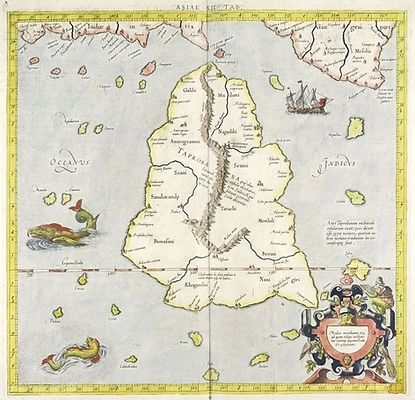
Image. David Rumsey Map Collection, David Rumsey Map Centre, Stanford Libraries.
Published by Godefridi Kempensis in Cologne, this edition of Claudius Ptolemy’s map of Ceylon was prepared by Gerhard Mercator. The maps were first printed, without the text of the Geographia, engraved on copper plates by Mercator himself.
1550
Chart Showing The Maldives And The Tip Of Sri Lanka

Image courtesy of Rijksmuseum Amsterdam.
A chart showing the Maldives and the tip of Sri Lanka created by an anonymous draughtsman sometime between 1550 and 1650.
1540
Asiae Tabula XII

mage. David Rumsey Map Collection, David Rumsey Map Centre, Stanford Libraries.
A map from within the first edition of Sebastian Munster’s Geographia Universalis, which represented the famous map of Ptolemy, with revised maps and text. Munster (1448-1552) was a mathematician, geographer and professor at Basel University and author of the influential Cosmographia Universalis. This map of the Island of Ceylon shows cities, towns, landmarks, rivers and mountains.
700
Map Of Ancient Indian Languages From The 3rd Century BCE To The 7th Century CE

Image courtesy of Theth Panjabi.
This map of the ancient Indian Middle Indo-Aryan languages shows their development and zone of influence from the 3rd century BCE to the 7th century CE. One of the two that most closely pertains to Sri Lanka is Elu, considered the earliest form of the Sinhalese language, with origins in the 3rd century BCE. The second was Tamil, one of the longest-surviving classical languages in the world, with an extensive body of literature dating back to at least 500 BCE. But whilst Singhala is a descendant language of Sanskrit, an ancient language that emerged around 1500 BCE, Tamil is not.
1548
Tabula Asiae XII

Image. David Rumsey Map Collection, David Rumsey Map Centre, Stanford Libraries.
This engraved map of the island of Ceylon, showing settlements, towns, landmarks, rivers and mountains, was part of La Geografia Di Claudio Ptolemeo Alessandrino and was published in Venice by Baptista Pedrezano. The map marked a first by being engraved on copper rather than rendered in woodcut, the work of Giacomo Gastaldi, the famous Italian cartographer.
1596
The Sea Coasts Of Abyssinia, The Indian Subcontinent, Ceylon, And The Kingdom Of Bengal

Image. David Rumsey Map Collection, David Rumsey Map Centre, Stanford Libraries.
A map created by Jan Huygen van Linschoten (1563-1611), a Dutch spy, merchant, traveller and writer who was based for several years in Goa. His covert reports about Asian trade and navigation - hidden by the Portuguese – were published in his book “Itinerario.” Its highly detailed nautical data enabled the Dutch East India Company and the British East India Company to break the 16th-century Portuguese monopoly on trade with the East Indies.