
The Ceylon Press Atlas Of Eighteenth Century Sri Lanka
A work-in-progress - exploring the story of Sri Lanka from 1700 - 1799 through the maps of its forgotten cartographers & explorers. To pull up a larger image of any map, double-click on the illustration.
1771
Map Of The Southern Part Of Ceylon
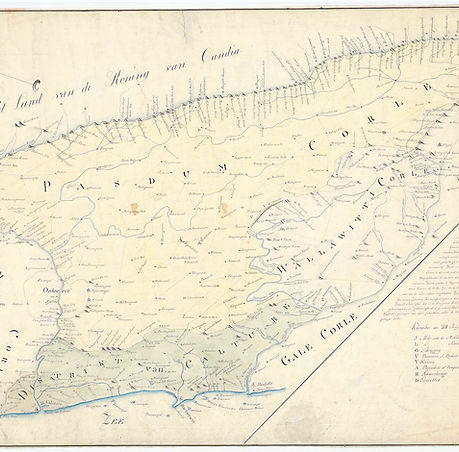
Image courtesy of Nationaal Archief.
A Dutch map of the southern part of Ceylon created by Iman Willem Falck and JL Guyard.
1767
Map Of An Area In The Region Of Negombo, Ceylon.

Image courtesy of Universiteitsbibliotheek Leiden.
This map, created by Baltus Jacobsz. van Lier is inscribed “map of the province of Prince King Wil-Elie: on the occasion of the township there adjoining…” The Dutch captured Negombo from the Portuguese in 1644, and it became a vital part of the colony due to the lucrative cinnamon trade and its strategic position north of Colombo, with a fort and a canal used to transport goods.
1743
Map of Mature and the Baygam Part D

Image courtesy of Nationaal Archief.
A Dutch map (1 of 5) by the cartographer CP Keller, depicting a slice of land close to Hakmana, north-east of Mature, on a tributary of the Tangale River. The territory was overseen by a small VOC fort at Katuwana, which, together with the fort at Akurressa, was intended to safeguard the link between the coast and the border town of Katuwana.
1742
Carte de l'Isle de Ceylan

Image. David Rumsey Map Collection, David Rumsey Map Centre, Stanford Libraries.
Created by Guillaume de L'Isle (1675-1726) and published by Covens & Mortier in Amsterdam, this engraved map in outline colour shows forested areas, pictorial relief and ocean depths by soundings.
1719
Map of Ceylon

Image courtesy of Nationaal Archief.
An early Dutch map of Ceylon.
1765
Map Of The Kingdom Of Candy On Ceylon

Image courtesy of Universiteitsbibliotheek Leiden.
A remarkable map created sometime between 1765 and 1770 by an unknown Dutch cartographer of the Kandyan kingdom, showing just how formidable its natural defences were.
1733
Peninsula Indiae

Image. David Rumsey Map Collection, David Rumsey Map Centre, Stanford Libraries.
A Swedish map discovered in the library of Lund University, through its publisher remains obscure.
1719
Nouvelle Carte De L'île De Ceylon

Image. David Rumsey Map Collection, David Rumsey Map Centre, Stanford Libraries.
Created by Chatelain Henri (1684-1743) and published by L'Honore & Chatelai, Freres Chatelain, this is a map from the first edition of a 7-volume Historical atlas of the world, the Atlas Historique. Although the text's primary focus was geography, the atlas also included a wealth of historical, political, and genealogical information. It was intended for a general public fascinated by recently conquered colonies and new discoveries. The engraved map of Sri Lanka shows towns, roads, the locations of Dutch forts, mines, rivers, and mountains, and depicts numerous elephants.
1743
Map of Mature and the Baygam Part B

Image courtesy of Nationaal Archief.
A Dutch map (1 of 5) by the cartographer CP Keller, depicting a slice of land close to Hakmana, north-east of Mature, on a tributary of the Tangale River. The territory was overseen by a small VOC fort at Katuwana, which, together with the fort at Akurressa, was intended to safeguard the link between the coast and the border town of Katuwana.
1753
Map Of The Northern Part Of Ceylon

Image courtesy of Nationaal Archief.
Created by an anonymous cartographer, this map shows two of the corles or revenue districts in northern Sri Lanka - Hapitigam and Alloetcoer.
1743
Map of Mature and the Baygam Part E

Image courtesy of Nationaal Archief.
A Dutch map by the cartographer CP Keller, depicting a slice of land close to Hakmana, north-east of Mature, on a tributary of the Tangale River. The territory was overseen by a small VOC fort at Katuwana, which, together with the fort at Akurressa, was intended to safeguard the link between the coast and the border town of Katuwana.
1744
Jafnapatnam

Image: Public Domain.
A map of Jafnapatnam created by the Dutch missionary Philippus Baldaeus, whose book "A True and Exact Description of the Most Celebrated East-India Coasts of Malabar and Coromandel, and also of the Isle of Ceylon", created a wave of interest in the colony right across Europe.
1700
Map Of Cinnamon Gardens At Paneture, Ceylon

Image courtesy of Nationaal Archief.
This map by C. van Houten was created sometime between 1700 and 1800 and shows the cinnamon gardens at Paneture, an area near Kalutara important for cinnamon cultivation. The VOC exported around 10,000 bales of cinnamon annually, generating an unprecedented income of 2.5 million guilders per year. And they were ruthless in implementing strategies to maintain their monopoly and keep prices high. They deliberately burned wild cinnamon forests to create artificial scarcity and established strict quality controls reinforced by a monopoly
1770
Colombo
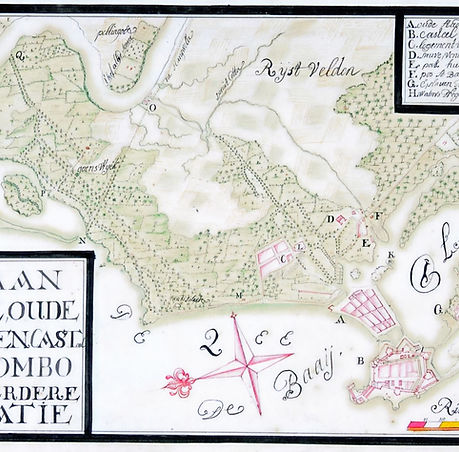
Image courtesy of Universiteitsbibliotheek Leiden.
A Dutch drawing of Colombo by an unknown draftsman created close to the end of Dutch rule over the island.
1750
Malabar, Madura, Ceylon And The Maldives

Image courtesy of Nationaal Archief.
A map of Malabar, Madura, Ceylon and the Maldives created sometime between 1750-1775 by an anonymous Dutch draftsman.
1700
Map Of The Part Of Mantotte And Nanaton On Ceylon

Image courtesy of Nationaal Archief.
This map, created sometime between 1700-1800 by an unknown Dutch cartographer, shows part of Mantotte and Nanaton – historically known as Manthottam in Tamil and Manthota or Mahathiththa in Sinhalese was an ancient port town in Mannar district and the main port of the Anuradhapura Kingdom.
1750
Map Of The Southwestern Coast Of Ceylon
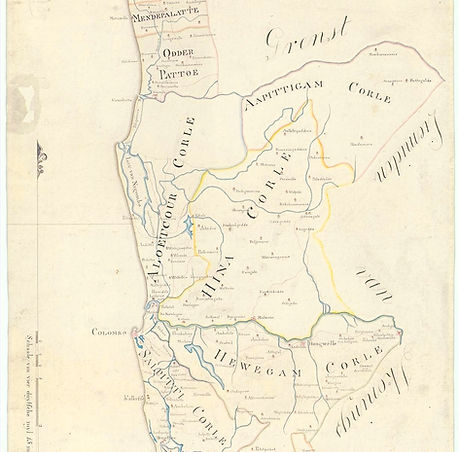
Image courtesy of Nationaal Archief.
Created by an anonymous draftsman sometime between 1750 and 1800 of the southwestern coast of Ceylon.
1746
Map Of Cattoecare Giant Tank Near Mannar

Image courtesy of Nationaal Archief.
This map of Cattoecare, or the ancient 'Reuzentank' (Giant Tank) near Mannar, by Jacobsz. van Baltus Lier, so carefully depicted in the chart, shows how greatly the Dutch came to rely on the extensive water system and water engineering from Sri Lanka’s ancient times
1729
Pieces Of Land, A Half Hour Hence From Hangwelle - A

Image courtesy of Nationaal Archief.
A map by the Dutch cartographer CP Boomgaard and inscribed “map of a piece of country called Cattoegalawille by the Inlanders, lying in the Hewegam Corla, in the village of Degambedde, about half an hour's gate from the fortress of Hangwell.” Hanwella was the largest of a string of Dutch forts along the River Kelani, built to tighten control over the interior. It included a house for the fiscal and warehouses for provisions and herbs. According to sources, the fort was manned by the Company's outcasts, who were not particularly welcome in Colombo.
1729
Pieces Of Land, A Half Hour Hence From Hangwelle - B
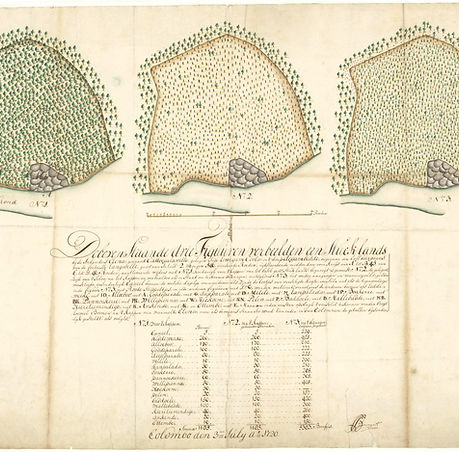
Image courtesy of Nationaal Archief.
A map by the Dutch cartographer CP Boomgaard and inscribed “map of a piece of country called Cattoegalawille by the Inlanders, lying in the Hewegam Corla, in the village of Degambedde, about half an hour's gate from the fortress of Hangwell.” Hanwella was the largest of a string of Dutch forts along the River Kelani, built to tighten control over the interior. It included a house for the fiscal and warehouses for provisions and herbs. According to sources, the fort was manned by the Company's outcasts, who were not particularly welcome in Colombo.
1743
Map of Mature and the Baygam Part F

Image courtesy of Nationaal Archief.
A Dutch map (1 of 5) by the cartographer CP Keller, depicting a slice of land close to Hakmana, north-east of Mature, on a tributary of the Tangale River. The territory was overseen by a small VOC fort at Katuwana, which, together with the fort at Akurressa, was intended to safeguard the link between the coast and the border town of Katuwana.
1743
Map of Mature and the Baygam Part A

Image courtesy of Nationaal Archief.
A Dutch map (one of several) by the cartographer CP Keller, depicting a slice of land close to Hakmana, north-east of Mature, on a tributary of the Tangale River. The territory was overseen by a small VOC fort at Katuwana, which, together with the fort at Akurressa, was intended to safeguard the link between the coast and the border town of Katuwana.
1776
Map Showing The Expedition To Candy

Image courtesy of Universiteitsbibliotheek Leiden.
The Dutch Governor Baron van Eck's expedition to capture Kandy was a mixed success, with the city briefly captured at great cost. Eck died shortly afterwards, and it was left to his successor, Willem Falck, to finally conclude a treaty in 1776 with the Kandyan King, Kirti Sri Raja Sinha. This gave the Dutch a monopoly on all trade, except for elephants, in the areas they controlled. The map is engraved - “Map of the marches, made by the different commands to take Candie, under orders from Mr John, the Baron van Ek, Governor of the island of Ceylon, / and raised by his orders on 2. January 1765 and put in net to be presented to Monsignor van der Parra Governor-General of Establishments for the Dutch Company of in the East Indies, 12 March 1766 by J.L. Guijard by the cares of Mr. Governor Falk.”
1750
Map Of Cinnamon Gardens in Alloetkorekorle

Image courtesy of Nationaal Archief.
This Dutch map by D Matthysz shows cinnamon gardens Alloetkorekorle, thought to be in Uva province.
1733
Peninsula Indiae, Malabar, Coromandel, Ceylon

Image. David Rumsey Map Collection, David Rumsey Map Centre, Stanford Libraries.
A map from an atlas by Homann, Seutter, Lotter, and others which range from 1702 to 1791, this map being created Johann Baptist Homann (1663-1724).
1726
Mannar

Image courtesy of Lankapura.com.
An engraved print of the Dutch VOC fortress created by François Valentyn for his monumental work - “Oud en Nieuw Oost-Indiën” (Old and New East Indies). Mannar Fort was built by the Portuguese in 1560, fell to the Dutch in 1658, and to the British in 1795.
1753
Map Of The Area Around Colombo And Negombo
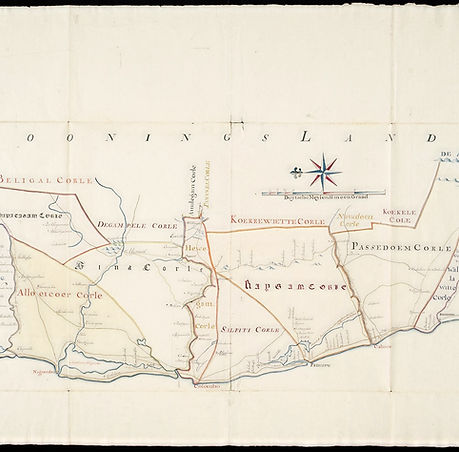
Image courtesy of Nationaal Archief.
Created by an anonymous Dutch cartographer, the map shows the area around Colombo and Negombo in the same year the Dutch precipitated a new war with Kandy over elephant trade, which by 1760 grew into a violent insurrection.
1726
The City Of Galle

Image: Public Domain.
An engraved print from: “Oud en Nieuw Oost-Indiën” (Old and New East Indies) by François Valentyn. This monumental work was published in parts between 1724 and 1726 – an eight-volume text filled with maps, illustrations, and vast details on the Dutch East India Company's territories.
1751
VOC Dutch Ceylon Fortifications

Image courtesy of Battlemaps.us.
This map was presented to the Governor of Dutch Ceylon, Gerard Joan Vreeland, on the day he took office, 24 September 1751. It was created by Baltus Jacobsz. van Lier. It depicts the plans for 22 forts on Ceylon, making clear that the VOC believed it could sustain its colonial grip through strong defensive power.
1739
Map of Carretchie near Jafnapatnam

Image courtesy of Nationaal Archief.
A Dutch map created by J.H. Steijn and A. van Manheijm that shows land and villages near Jaffna.
1750
Map of Ceylon

Image courtesy of Universiteitsbibliotheek Leiden.
Created sometime between 1750 and 1770 by the Dutch cartographer Baltus Jacobsz. van Lier, this map of Ceylon shows the cattle and elephants in each district.
1721
Les Indes Orientales

Image. David Rumsey Map Collection, David Rumsey Map Centre, Stanford Libraries.
Published by N. De Fer in Paris, the maps states that its subject is “The East Indies: under the name of which is included the empire of the Great Mughal, the two peninsulas of Ceylon and the Ganges, the Maldives, and the island of Ceylon, to which some also add the large islands of the Sunda archipelago, which are Sumata, Java, and Borneo; the Philippines; and the Moluccas.” De Fer was the official cartographer of the King of Spain and had a reputation for work that was more artistic than accurate.
1779
Map and Elevations of Fort Oostenburg

Image courtesy of Nationaal Archief.
A Dutch map by W Löwe showing the elevations of Fort Oostenburg, a now long-forgotten fort held by the Portuguese, Dutch, and British on a ridge overlooking Trincomalee.