
The Ceylon Press Atlas Of Seventeenth Century Sri Lanka
A work-in-progress - exploring the story of Sri Lanka from 1600 to 1699 through the maps of its forgotten cartographers & explorers. To pull up a larger image of any map, double-click on the illustration.
1600
Narfinga Et Ceylon

Image courtesy of Lankapura.com.
Dating from somewhere between 1600 and 1618, this map of South India and Sri Lanka was created by Petrus Bertius (1565 –1629), a Flemish theologian, historian, and cartographer.
1624
Map of Chilao

Image courtesy of Nationaal Archief.
This map of Chilao is based on the maps and descriptions made by Constantine de Sa en Noronha, captain-general of Ceylon from 1618 to 1620 and 1623 to 1630.
1624
Map Of The Fort Of Sofragam

Image courtesy of Nationaal Archief.
This map of the fort of Sofragam is based on the maps and descriptions made by Constantine de Sa en Noronha, captain-general of Ceylon from 1618 to 1620 and 1623 to 1630.
1637
The Iland Zeiland

Image. David Rumsey Map Collection, David Rumsey Map Centre, Stanford Libraries.
This copper-engraving uncoloured map of the island of Sri Lanka was part of a 1032-page atlas published by
T. Cotes for Michael Sparke and Samuel Cartwright in London, and copies the map created by Mercator Hondius in his 1607 work, Atlas Minor.
1697
Plan For Alterations To The Castle At Colombo

Image courtesy of Nationaal Archief.
A plan for alterations to the Dutch fort in Colombo by Jan Christiaensz Toorzee. After the capture of Colombo in 1656, the VOC realised that the full extent of the Portuguese fortress could not be successfully defended. It was therefore decided to separate the core part, which they called the ‘Castle’, and the residential area.
1680
Map Of The East Coast Of India And A Part Of The West Coast On The Island Of Ceylon

Image courtesy of Nationaal Archief.
Created sometime between 1680 and 1730 by the cartographer Isaac de Graaff, this map of the east coast of India and a part of the west coast on the island of Ceylon shows the fine detail of Adam’s Bridge.
1660
Map Of Colombo During The VOC’s Siege

Image courtesy of Biblioteca Medicea Laurenziana.
The map by Johannes Vingboons, created sometime between 1660 and 1667, shows Colombo, with its main streets and buildings, its city defences and the siege works that VOC troops erected during their siege of the town in 1655-1656.
1623
Ceilan Quae Incolis

Image. David Rumsey Map Collection, David Rumsey Map Centre, Stanford Libraries.
Published by Hendricus Hondius in Amsterdam, the detail notes that this is a map of “Ceylon, which is called Tenaris by the inhabitants. The most illustrious man, Petrus Plancius, described this island, drawn by Cyprian Sanchez, the Spanish cosmographer, to be inserted into this work of ours.” Its claim to show “Ceylon with inhabitants” is rendered more exciting by the manifold presence of many wild animals.
1665
Bird's Eye View Of Colombo And Environs

Image courtesy of Nationaal Archief.
A stunning coloured map by Johannes Vingboons that gives an aerial view of Colombo and its environs.
1650
Insula Zeilan olim Taprobana nunc incolis Tenarisi
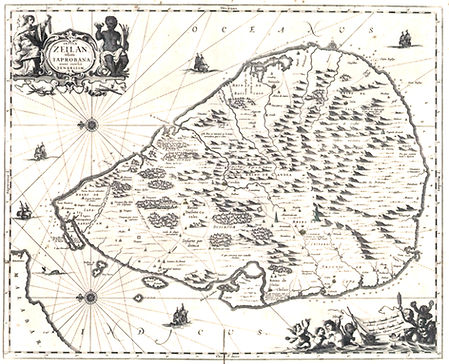
Image. David Rumsey Map Collection, David Rumsey Map Centre, Stanford Libraries.
A map of Ceylon that made up what was considered to be the first true sea atlas. It was published in Amsterdam within the fifth volume of Johannes Jansson’s (1588-1664) Atlas Novus.
1624
Map of Gale

Image courtesy of Nationaal Archief.
This map of Galle is based on the maps and descriptions made by Constantine de Sa en Noronha, captain-general of Ceylon from 1618 to 1620 and 1623 to 1630.
1656
Map of Ceylon with Adams Bridge

Image courtesy of Nationaal Archief.
A map of Adam’s Bridge created by an anonymous cartographer sometime between 1656 and 1725.
1665
Bird's Eye View Of Negombo

Image courtesy of Nationaal Archief.
An aerial view of Negombo by an anonymous draughtsman showing the fort in the centre.
1636
Ceilan

Image. David Rumsey Map Collection, David Rumsey Map Centre, Stanford Libraries.
A copper-engraved map of the island of Sri Lanka that shows towns, villages, landmarks, mountains, and rivers, published by Apud Joannem Janssonium.
1675
Map Of The Western Coast Of Ceylon From Manaar To Negombo

Image courtesy of Nationaal Archief.
A drawing by an anonymous draughtsman of the western coast of Ceylon from Manaar to Negombo, created sometime between 1675 and 1775.
1690
Map Of The East Coast Of India And Part Of The West Coast Of The Island Of Ceylon

Image courtesy of Nationaal Archief.
Created sometime between 1690 and 1743, this map depicts the east coast of India and part of the west coast of Ceylon. It was created by Isaak de Graaff (1668- 1743), a Dutch mapmaker who received a commission to produce an Atlas of Africa and Asia for the Dutch East India Company, which could then be used by their governing council when considering policy. After this was completed in 1705, he was appointed their official cartographer.
1672
The Dutch Fort of Jaffna Patnam

Image: Public Domain.
This map was published in "A True and Exact Description of the Most Celebrated East-India Coasts of Malabar and Coromandel, and also of the Isle of Ceylon" - a 17th-century travelogue by Dutch missionary Philippus Baldaeus, detailing his observations in South India and Sri Lanka, and covering geography, culture, Hindu idolatry, flora, fauna, and conflicts between Portuguese and Dutch forces. It depicts a hilltop perspective of the fort built by the Portuguese and captured by the Dutch after a three-month siege in 1658. The kingdom of Jaffnapatnam consisted of 13 islands and four provinces, and the Dutch maintained rule for 138 years.
1667
Map Of The West Coast Of Ceylon From Manarbel To Punto Gale

Image courtesy of Nationaal Archief.
Created by an unknown Dutch cartographer, this map of the west coast of Ceylon reaches from Manarbel to Galle.
1624
Map Of The Castle Of Colombo

Image courtesy of Nationaal Archief.
This map of the castle of Colombo is based on the maps and descriptions made by Constantine de Sa en Noronha, captain-general of Ceylon from 1618 to 1620 and 1623 to 1630.
1665
Map Of The Northern Part Of Ceylon And A Part Of India's Coromandel Coast

Image courtesy of Österreichische Nationalbibliothek.
Created by the Dutch cartographer Johannes Vingboons sometime between 1665 and 1668, this map of northern Ceylon also shows part of India's Coromandel Coast and marks the Dutch fort with flags. It is part of the Blaeu-Van der Hem Atlas.
1624
Map of Trinconomale

Image courtesy of Nationaal Archief.
This map of Trincomalee is based on the maps and descriptions made by Constantine de Sa en Noronha, captain-general of Ceylon from 1618 to 1620 and 1623 to 1630.
1682
Isle de Ceilan

Image. David Rumsey Map Collection, David Rumsey Map Centre, Stanford Libraries.
A map from a 2-volume atlas made by Pierre Du Val (1619-1683) and published in Paris by Chez Pierre Du Val and Chez Nicolas.
1624
Sketch of Negumbo

Image courtesy of Nationaal Archief.
This sketch of the land at Negombo is based on the maps and descriptions made by Constantine de Sa en Noronha, captain-general of Ceylon from 1618 to 1620 and 1623 to 1630.
1665
Map Of The Island Of Ceylon

Image courtesy of Österreichische Nationalbibliothek
The Dutch map created sometime between 1665 – 1668 for the Blaeu-Van der Hem Atlas by Johannes Vingboons, with flags marking the Dutch forts.
1624
Map of Tanavare

Image courtesy of Nationaal Archief.
This map of the tiny fort at Tanavare near Batticaloa is based on the maps and descriptions made by Constantine de Sa en Noronha, captain-general of Ceylon from 1618 to 1620 and 1623 to 1630. No traces of it exist today.
1624
Map of Batecalo

Image courtesy of Nationaal Archief.
This map of Batecalo is based on the maps and descriptions made by Constantine de Sa en Noronha, captain-general of Ceylon from 1618 to 1620 and 1623 to 1630.
1624
Map of Manar

Image courtesy of Nationaal Archief.
This map of Manar is based on the maps and descriptions made by Constantine de Sa en Noronha, captain-general of Ceylon from 1618 to 1620 and 1623 to 1630. .
1624
Map of Gale

Image courtesy of Nationaal Archief.
This map of Galle is based on the maps and descriptions made by Constantine de Sa en Noronha, captain-general of Ceylon from 1618 to 1620 and 1623 to 1630.
1624
Map of Trinconomale

Image courtesy of Nationaal Archief.
This map of Trincomale is based on the maps and descriptions made by Constantine de Sa en Noronha, captain-general of Ceylon from 1618 to 1620 and 1623 to 1630.
1624
Map Of Colombo

Image courtesy of Nationaal Archief.
This map of Colombo is based on the maps and descriptions made by Constantine de Sa en Noronha, captain-general of Ceylon from 1618 to 1620 and 1623 to 1630.
1660
Map of Galle

Image courtesy of Biblioteca Medicea Laurenziana.
This Dutch map of Galle by Johannes Vingboons emphasises the city's defensive structure, as well as its main buildings and street grid.
1659
Bird's-Eye View Map Of The City Of Gale

Image: Public Domain.
An unusual coloured drawing of Galle, its origins obscure – as seen from high above.
1652
Ceylon et les Maldives

Image. David Rumsey Map Collection, David Rumsey Map Centre, Stanford Libraries.
A very rare map by Nicolas Sanson (1600-1667) and published by his son, Guillaume Sanson (1633-1703) as Cloistre de S Nicolas du Louvre, in French and Latin. The title page is dated 1697 but the latest date on a map in the atlas is 1709. It was part of a 3 volume set.
1618
Asiae, XII Tab

Image. David Rumsey Map Collection, David Rumsey Map Centre, Stanford Libraries.
A hand coloured outline map of Ceylon published by Isaacus Elzevirius, Iudoci Hondii, and Lugduni Batavorum, and based primarily on Ptolemy's Geographia, produced around 150 CE.
1624
Map of Calpeti and Putalam

Image courtesy of Nationaal Archief.
This map Calpeti and Putalam is based on the maps and descriptions made by Constantine de Sa en Noronha, captain-general of Ceylon from 1618 to 1620 and 1623 to 1630.
1606
Map of Ceylon

Image courtesy of Nationaal Archief.
Created by an anonymous cartographer sometime between 1606-1625, this early Dutch map of Ceylon was probably based on a Portuguese original.
1624
Map of Mature

Image courtesy of Nationaal Archief.
This map of the fort at Mature is based on the maps and descriptions made by Constantine de Sa en Noronha, captain-general of Ceylon from 1618 to 1620 and 1623 to 1630.
1624
Bird's Eye View Of Alicao

Image courtesy of Nationaal Archief.
This view of Alicao is based on the maps and descriptions made by Constantine de Sa en Noronha, captain-general of Ceylon from 1618 to 1620 and 1623 to 1630.
1624
Map of Jaffnapatnam

Image courtesy of Nationaal Archief.
This map of Jaffnapatnam is based on the maps and descriptions made by Constantine de Sa en Noronha, captain-general of Ceylon from 1618 to 1620 and 1623 to 1630.
1624
Map of Caleture

Image courtesy of Nationaal Archief.
This map of the fort at Caleture is based on the maps and descriptions made by Constantine de Sa en Noronha, captain-general of Ceylon from 1618 to 1620 and 1623 to 1630.
1624
Map of Negumbo

Image courtesy of Nationaal Archief.
This map of Negombo is based on the maps and descriptions made by Constantine de Sa en Noronha, captain-general of Ceylon from 1618 to 1620 and 1623 to 1630.
1650
Map of Ceylon and the Coast of Madure

Image courtesy of Nationaal Archief.
A Dutch drawing of the island by an unknown draughtsman marked as “Kaart van het Eiland Ceylon en de Kust van Madure” and thought to be created sometime between 1650 to 1700
1624
Map of S. Lourenso in Columbo

Image courtesy of Nationaal Archief.
This map of S. Lourenso in Columbo is based on the maps and descriptions made by Constantine de Sa en Noronha, captain-general of Ceylon from 1618 to 1620 and 1623 to 1630.
1624
Map of Belligam

Image courtesy of Nationaal Archief.
This map of Belligam is based on the maps and descriptions made by Constantine de Sa en Noronha, captain-general of Ceylon from 1618 to 1620 and 1623 to 1630.
1624
Map Of The Fort Of Manieravare

Image courtesy of Nationaal Archief.
This map of the fort at Manieravare is based on the maps and descriptions made by Constantine de Sa en Noronha, captain-general of Ceylon from 1618 to 1620 and 1623 to 1630.
1607
Ceilan Insula

Image. David Rumsey Map Collection, David Rumsey Map Centre, Stanford Libraries.
This map of Ceylon was part of the Atlas minor Gerardi Mercatoris atlas, published by Ioannes Janssonius, and shows the boundaries, territories, topographical features, cities and towns, landmarks, rivers, forests, and even sea monsters. In using the maps of Gerardus Mercator, it relied on the work of one of the greatest cartographers of the sixteenth century, a man who helped establish Amsterdam as the leading centre of 16th-century cartography. Gerard Mercator was a philosopher, land surveyor, cartographer, and engraver, and is famous for developing the technique of rendering the globe on a flat surface – "Mercator’s projection."