
The Ceylon Press Atlas Of Twentieth Century Sri Lanka
A work-in-progress - exploring the story of Sri Lanka from 1900-1999 through the maps of its forgotten cartographers & explorers. To pull up a larger image of any map, double-click on the illustration.
1952
Asia Anteriore. India, Pakistan, Ceylon, Birmania

Image. David Rumsey Map Collection, David Rumsey Map Centre, Stanford Libraries.
One of a series of thematic maps showing crops, minerals, land cover, products, and energy resources published by Instituto Geographico di Agostini and probably intended to accompany an encyclopedia.
1967
India, Pakistan, Nepal, Bhutan, Ceylon

Image. David Rumsey Map Collection, David Rumsey Map Centre, Stanford Libraries.
A map from the English edition of the Polish Atlas Swiata, a massive atlas that weighed nearly 5.5 kilograms, was published by the Pergamon Press in Oxford and was initially created by the Polish Army Topography Service - Wojskowe Zaklady Kartograficzne.
1904
Map of Ceylon

Image. David Rumsey Map Collection, David Rumsey Map Centre, Stanford Libraries.
A map from the magnificent full colour lithographic atlas published by Edward Stanford. It shows the island’s provinces in full colour, along with relief, settlements, roads, and railroads. First issued in 1887, it was the successor to John Arrowsmith's London Atlas of 1858 (Stanford acquired Arrowsmith's plates upon his death). The first issue of the second edition appeared in 1893, with updated second editions of 1896, 1898, and 1901. The third edition was issued in 1904, and Phillips (mistakenly) shows the next and last edition as 1928 – although it was actually 1931.
1952
Asia Anteriore. India, Pakistan, Ceylon, Birmania
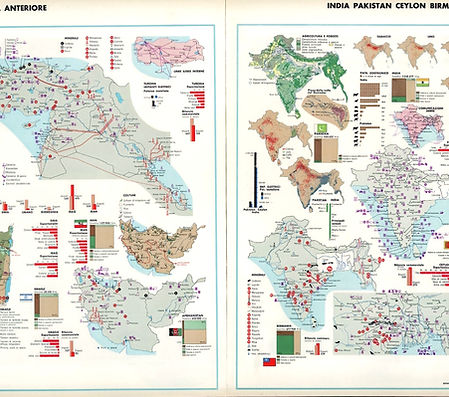
Image. David Rumsey Map Collection, David Rumsey Map Centre, Stanford Libraries.
Published by the Instituto Geographico di Agostini in an encyclopaedic atlas of small maps showing, crops, minerals, land cover, products, and energy resources.
1901
Ceylon

Image. David Rumsey Map Collection, David Rumsey Map Centre, Stanford Libraries.
Published by Edward Stanford of Long Acre, London, within the London atlas series
1943
Ceylon

Image. David Rumsey Map Collection, David Rumsey Map Centre, Stanford Libraries.
This map, from the Atlas of India, published by the Map House & Indian Book Depot in Lahore, shows political boundaries, major cities, railroads, roads, lakes, drainage and coastlines, as well as air routes and bay and ocean routes with distances between ports.
1967
South India and Ceylon. Burma

Image. David Rumsey Map Collection, David Rumsey Map Centre, Stanford Libraries.
This map from the second edition of the Atlas of the World (1st edition in 1954) was published by Topics Physical Publisher USSR in Moscow and stated that "The second edition of the World Atlas is issued at a time when all progressive people of the globe are celebrating the 50th anniversary of the Great October socialist revolution."
1911
India

Image. David Rumsey Map Collection, David Rumsey Map Centre, Stanford Libraries.
Published by W.& A.K. Johnston in Edinburgh, this map, within their General Atlas, shows countries and districts outlined in colour.
1998
Coca-Cola Map Bottles Of The World

An undated map by Manuel and SmashGamer16 showing a preponderance of cola bottles, none of which hover directly over Sri Lanka.
1931
McCormick's Map of the World

Image. David Rumsey Map Collection, David Rumsey Map Centre, Stanford Libraries.
Created by McCormick & Co., Inc., importers, exporters, and packers in Baltimore, U.S.A., this advertising map of the world features vignette illustrations at the corners: Native Tea Pickers of Ceylon, Natives Pulling Vanilla Beans in Mexico, Workers Loading Spices in India. It also includes an image of the McCormick building, a list of countries with their flags, and a selection of Bee Brand products.
1943
India, Burma & Ceylon

Image. David Rumsey Map Collection, David Rumsey Map Centre, Stanford Libraries.
A coloured map of India, Burma and Ceylon that shows political boundaries, major cities, railroads, roads, lakes, drainage and coastlines, as well as air routes and ocean routes with distances between ports. It was created by Biba Singh Kaushal and published in Lahore by Map House & Indian Book Depot.
1967
Vietnam, Laos, Cambodia, India, Pakistan, Nepal, Ceylon

Image. David Rumsey Map Collection, David Rumsey Map Centre, Stanford Libraries.
A map of Vietnam, Laos, Cambodia, India, Pakistan, Nepal, Ceylon, created by the Polish Army Topographical Service and published in the Pergamon World Atlas by Pergamon Press, Ltd., in Oxford. In a range of small maps and graphics, it depicts population, land use, agriculture, industry, power, relief types, mining, metallurgy, climate, crops, and foreign trade.
1925
India-Southern Section and Ceylon

Image. David Rumsey Map Collection, David Rumsey Map Centre, Stanford Libraries.
A thematic map which was part of an atlas published in New York by the Institute of Social and Religious Research.
1948
India

Image. David Rumsey Map Collection, David Rumsey Map Centre, Stanford Libraries.
Published by the Garden City Publishing Company, a notable American publisher originally a branch of Doubleday, best known for its reprints of popular books by authors such as Rudyard Kipling and William Somerset Maugham.
1915
India Showing Railways Open And Under Construction

Image. David Rumsey Map Collection, David Rumsey Map Centre, Stanford Libraries.
Published under the direction of Colonel Sir S.G. Burrad, the Survey General of India at the Survey of India Office, Calcutta, this colour map of the Indian railway systems shows international and administrative boundaries, railways and roads.
1904
Vorder-Indien und Inner-Asien

Image. David Rumsey Map Collection, David Rumsey Map Centre, Stanford Libraries.
Published by Justus Perthes in Gotha, the map depicts the Indian subcontinent.
1936
Survey Department Motor Map of Ceylon

Image. David Rumsey Map Collection, David Rumsey Map Centre, Stanford Libraries.
A map that depicts all of Ceylon’s transportation network. The island’s topography is precisely expressed based upon the latest official surveys, with elevations shown by altitude tints; and symbols identify major motor roads, other motor roads, paths, ferries, railways, petrol stations, rest houses, hotels and telephone boxes; petrol depots, police stations with telegraph offices, rest houses and hotels, hospitals and pharmacies, circuit bungalows, railway stations with automobile rental offices, and climate data for many locations. The map was compiled by William Samuel Maddams (1877 - 1958), then Ceylon’s Assistant Superintendent of Surveys, an experienced cartographer who first learned surveying and draftsmanship while fighting in East Africa during World War I. He subsequently spent many years engaged by the Ceylon Survey Department in Colombo, where he drafted many of the era’s most important maps of the island. The present map is part of a sequence of Motor Maps of Ceylon, issued by the Survey Department in regularly updated editions from 1918 to 1973.
1906
Madras, Orissa & Ceylon

Image. David Rumsey Map Collection, David Rumsey Map Centre, Stanford Libraries.
First published in 1897 by W. & A.K. Johnston Limited of Edinburgh, this map comes from a later edition published in 1906.
1959
Indian Ocean

Image. David Rumsey Map Collection, David Rumsey Map Centre, Stanford Libraries.
Created by The Geographical Institute of Edinburgh and published by Houghton Mifflin Co. and John Bartholomew & Son in London and Boston, this map is from a 5-volume atlas.
1908
Map Of Railway Systems In India, Burma & Ceylon

Image. David Rumsey Map Collection, David Rumsey Map Centre, Stanford Libraries.
This map was compiled for the Railway Board of India by J.H. Trott in Moradabad, exhibited by the British Government at the Franco-British Exposition in London in 1908, and later published in 1915.
1911
Vorder-Indien

Image. David Rumsey Map Collection, David Rumsey Map Centre, Stanford Libraries.
Published by Justus Perthes in Gotha, the map shows the British domains in India and Sri Lanka.
1925
Manuscript Map of Ceylon

Image courtesy of Geographicus Rare Antique Maps.
A small map that shows the island's climate, topography, economy, infrastructure, and demographics. Arrows indicate the direction and months of the seasonal monsoons, and the map is adorned with illustrations of ships, elephants, and mountains. It dates to 1925 as the railway network's Main Line appears to reach Badulla, a connection completed in 1924. The name of the cartographer is illegible.
1915
India Showing Railways Open And Under Construction
Image. David Rumsey Map Collection, David Rumsey Map Centre, Stanford Libraries.
This colour map of the Indian railway system includes insets for Bombay, Cawnpore, Madras, Ceylon and Agra – and covers what is today Pakistan and Bangladesh. Published under the direction of Colonel Sir S.G. Burrad, the Survey General of India from the Survey of India Office in Calcutta, it shows international and administrative boundaries, railways and roads.
1901
Ceylon

Image. David Rumsey Map Collection, David Rumsey Map Centre, Stanford Libraries.
Published by Geo. F. Cram in Chicago as a map within Cram's Atlas Of The World, Ancient And Modern, showing provinces, cities and towns, roads.
1934
Map of Ceylon's Tea Industry
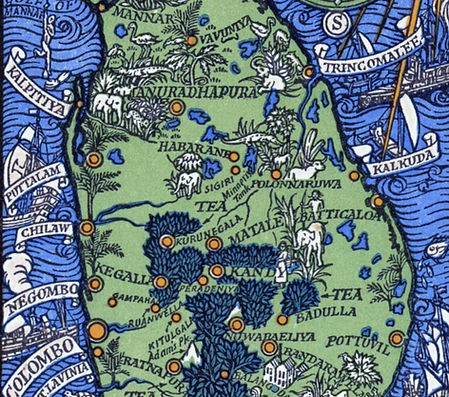
Image. David Rumsey Map Collection, David Rumsey Map Centre, Stanford Libraries.
A colour pictorial postcard map designed by MacDonald Gill (1884-1947) and printed in Ceylon. It formed advertising and promotional campaign of the Ceylon Tea Propaganda Board in the early 1930's and shows principal tea growing region, wildlife, and ships on the ocean. Major coastal ports and settlements are noted by means of unfurled scrollwork banners.
1937
A Great Industry: Where Our Tea Comes From

Image. David Rumsey Map Collection, David Rumsey Map Centre, Stanford Libraries.
One of three lithograph pictorial maps, produced in 1937 by Macdonald Gill (1884-1947) for the Tea Market Expansion Board, and depicting the local landmarks, industries and wildlife of Britain’s main tea suppliers in the early twentieth century: India, Ceylon, Java and Sumatra. Gill was one of Britain’s leading graphic designers and cartographers and was the brother of Eric Gill, one of the principal figures of the Arts and Crafts movement.