
The Ceylon Press Atlas Of Nineteenth Century Sri Lanka
A work-in-progress - exploring the story of Sri Lanka from the year 1800 to 1899 through the maps of its forgotten cartographers & explorers. To pull up a larger image of any map, double-click on the illustration.
1845
Ceylon

Image. David Rumsey Map Collection, David Rumsey Map Centre, Stanford Libraries.
A hand coloured map, with outline colour by boundaries that shows cities, rivers, and roads. It was published by G.F. Cruchley in London and was created by A. Arrowsmith, Hydrographer to the King.
1893
Map of the Island of Ceylon

Image. David Rumsey Map Collection, David Rumsey Map Centre, Stanford Libraries.
Published by the Ceylon Observer Office in Colombo and M. & J. Ferguson/ John Haddon & Co in London, this map states it was corrected up to 1893, and shows provinces, towns, principal and minor roads, railway and telegraph lines.
1801
Ceylon

Image. David Rumsey Map Collection, David Rumsey Map Centre, Stanford Libraries.
A map of Ceylon engraved for Luffman's Select plans by John Luffman (1756-1846), a 2-volume atlas of engraved, hand-coloured plans of cities, harbours, and ports around the world, plus some countries, regions, and islands.
1804
A New Map Of Hindoostan From The Latest Authorities

Image. David Rumsey Map Collection, David Rumsey Map Centre, Stanford Libraries.
Published by Laurie & Whittle in London, the map states that it was made “chiefly from the actual surveys made by Major James Rennell, Surveyor to the Hble. East India Company, of the Bengal Provinces, and of the countries lying between them and Delhy; the whole exhibiting all the military roads and passes, as well as the most accurate division of the British possessions in the East Indies.”
1862
Map of South India and Ceylon

Image. David Rumsey Map Collection, David Rumsey Map Centre, Stanford Libraries.
A colour map of South India created by the Church Missionary Society and published by Seeley, Jackson and Halliday in London. It shows roads, buildings, landmarks, rivers, major towns, rivers and mountains - and occasionally numbered references to churches and missions.
1844
India from Authorities Principally for Use of the Officers of the Army of India

Image. David Rumsey Map Collection, David Rumsey Map Centre, Stanford Libraries.
Published by Henry Teesdale & Co in London and drawn & engraved by J. Dower, this map features coloured margins for the states and shows cities, place names, roads, rivers, lakes, and islands. It depicts British possessions in red and lists states that are either tributary to, subsidiary to, or protected by the British. Settlements of other European powers are underlined in appropriate colour.
1838
Map Of The Peninsula Of India

Image. David Rumsey Map Collection, David Rumsey Map Centre, Stanford Libraries.
Published by James Wyld in London, this map is from Wyld’s New General Atlas Of Modern Geography. It covers the Indian provinces, extending from Aurangabad in the North to the northern half of Sri Lanka in the South, and depicts administrative boundaries, major cities, and towns.
1823
Hindoostan

Image. David Rumsey Map Collection, David Rumsey Map Centre, Stanford Libraries.
The first edition of Fielding Lucas' general atlas was considered the finest general atlas produced in the U.S. at the time, and this map from within it includes Nepal, Ceylon, and parts of Tibet. It was published in Baltimore by Fielding Lucas Jr.
1800
A Map Of The Peninsula Of India

Image. David Rumsey Map Collection, David Rumsey Map Centre, Stanford Libraries.
An engraved map that covers the peninsula of India from the 19th degree north latitude to Cape Comorin and the northern portion of Ceylon. It was published by W. Faden, Geographer to the King and to the Prince of Wales, from his offices in Charing Cross, London.
1831
Hindostan (with) Isle of Ceylon.

Image. David Rumsey Map Collection, David Rumsey Map Centre, Stanford Libraries.
A hand coloured, engraved map showing Ceylon, published by D. Lizars of Edinburgh.
1816
Southern Hindostan

Image. David Rumsey Map Collection, David Rumsey Map Centre, Stanford Libraries.
A coloured map that was drawn & engraved for Thomson's New general atlas by John Thomson and Samuel John Neele and published by Baldwin, Cradock, and Joy in London and Dublin.
1820
Geographical, Historical, and Statistical Map of India

Image. David Rumsey Map Collection, David Rumsey Map Centre, Stanford Libraries.
Published by M. Carey and Son in Philadelphia, the map is from the first American edition of the atlas, which was based on the 1817 London edition published by J. Barfield. The text provides a history and description of India, with locations of battles and sieges shown in chronological lists keyed to little flags on the maps.
1855
Colton's Hindoostan or British India

Image. David Rumsey Map Collection, David Rumsey Map Centre, Stanford Libraries.
Published in New York by G.W. & C.B. Colton, depicting British India with Sri Lanka.
1883
Statistical & General Map Of India

Image. David Rumsey Map Collection, David Rumsey Map Centre, Stanford Libraries.
Published by Letts, Son & Co. in London, this colour map, part of Letts's Popular Atlas, covers southern India and Sri Lanka and shows spot heights, cities, political divisions, European possessions, telegraph lines, roads, railroads, coffee plantations, forests, lights and lighthouses.
1806
A New Map Of Hindoostan
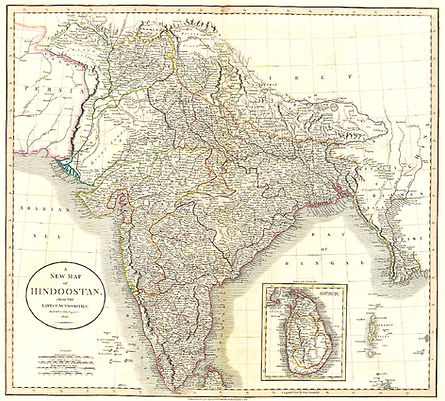
Image. David Rumsey Map Collection, David Rumsey Map Centre, Stanford Libraries.
Published within an atlas by the engraver John Cary (1754-1835), of No. 181, Strand, London, this atlas continued in new editions until 1844.
1830
Britisches Reich

Image. David Rumsey Map Collection, David Rumsey Map Centre, Stanford Libraries.
Published by Georg Joachim Goschen of Leipzig, this topographical map shows in red outline the British possessions in India, Ceylon and Malacca. The map formed part of a 3-volume set published in parts from 1825-1830.
1810
Carte Reduite Du Golfe De Bengale

Image. David Rumsey Map Collection, David Rumsey Map Centre, Stanford Libraries.
This French marine chart of the coastal area of the Gulf of Bengal from Ceylon to the Gulf of Siam shows ocean depths by soundings. It was based on French admiralty charts and published by the Depot Général de la Marine in France.
1810
Carte de la Baye et Port de Trinquemalay dans l'Isle de Ceylan

Image. David Rumsey Map Collection, David Rumsey Map Centre, Stanford Libraries.
This chart of the port of Trincomalee, Sri Lanka, shows sea depth by soundings and was part of a French marine atlas of the eastern oceans, updated to 1810 using French admiralty charts to provide a complete working atlas for officers navigating eastward. It was published by the Depot Generale de la Marine in Paris.
1899
Isobars & Isohyets of India

Image. David Rumsey Map Collection, David Rumsey Map Centre, Stanford Libraries.
Published by the Edinburgh Geographical Institute in association with J.G Bartholomew, the map was part of a planned 5-volume Bartholomew's Physical Atlas, though only the Meteorology and Zoogeography editions were ever published.
1819
The East Indies According To The General Acceptation

Image. David Rumsey Map Collection, David Rumsey Map Centre, Stanford Libraries.
Published by W. Faden (1749-1836) to accompany his Atlas Minimus Universalis, which he described as “a geographical abridgement ancient and modern of the several parts of the earth.” Faden was the royal geographer to King George III, a title given to various people in the 18th century, all of whom were engravers and publishers, not academics, and whose role was to publish and supply maps to the British crown and parliament.
1822
Sketch of the Outline and Principal Rivers of India

Image. David Rumsey Map Collection, David Rumsey Map Centre, Stanford Libraries.
This map was part of a failed attempt by Arrowsmith, Hydrographer to the King, to map India on a large scale (4 miles to 1 inch), but Arrowsmith’s death in 1823 meant that it was never fully completed.
1810
Carte Reduite De L'Océan Oriental Septentrional

Image. David Rumsey Map Collection, David Rumsey Map Centre, Stanford Libraries.
This chart of the Indian Ocean shows the coasts of Africa, Arabia, Iran, India and Ceylon, with depths shown by soundings. It was part of a French marine atlas that used French admiralty charts to provide a full working atlas for officers navigating eastward, and was published by the Depot Général de la Marine in France.
1806
Hindoostan

Image. David Rumsey Map Collection, David Rumsey Map Centre, Stanford Libraries.
A hand-painted map published by R. Wilkerson in London. "Hindoostan" was the historical and common name for the Indian subcontinent during the British colonial era, encompassing the entire Indian subcontinent
1851
Ceylon

Image. David Rumsey Map Collection, David Rumsey Map Centre, Stanford Libraries.
Drawn & Engraved by H. Winkles and J. Rapkin, this map of Ceylon was published in New York by J. & F. Tallis and shows the Island in outline colour by region, encircled by drawings of local lakes, mountains, ruins, and temples.
1882
Southern India, Including The Presidencies Of Bombay & Madras

Image courtesy of Middlebury College Special Collections.
Created by J. Rapkin, the cartographer and engraver, this map shows the British Indian presidencies of Bombay and Madras, with provincial borders delineated and vignettes along the margins featuring The Tomb of Mahomed Shar; Government House, Calcutta; and the Seal of the East India Company.
1863
Prequ'ile de L'Inde

Image. David Rumsey Map Collection, David Rumsey Map Centre, Stanford Libraries.
Published by Furne Et Cie in Paris, this map is from a beautifully engraved and coloured atlas created by August Stoher, by Joseph-Rose Lemercier, one of the most important Parisian printers and lithographers of the 19th century.
1846
Vorderindien

Image. David Rumsey Map Collection, David Rumsey Map Centre, Stanford Libraries.
A map of India and Sri Lanka published by Carl Flemming in Leipzig.
1875
Indien & Inner-Asien

Image. David Rumsey Map Collection, David Rumsey Map Centre, Stanford Libraries.
This engraved colour map from Stieler's Atlas, published by Justus Perthes, covers Sri Lanka, Pakistan, Bangladesh, Nepal, Bhutan, Tibet, and parts of China, Burma, Afghanistan, and Central Asia. The atlas was first published in 1817, with editions continuing well into the 20th century - the most comprehensive and best executed 19th-century German atlases.
1810
Carte Plate Qui Comprend l'Isle De Ceylan

Image. David Rumsey Map Collection, David Rumsey Map Centre, Stanford Libraries.
This French marine atlas of the eastern oceans, updated to 1810, used French admiralty charts to provide a complete working atlas for officers navigating eastward, with routes to the Red Sea, the coasts of India, China, northern parts of Indonesia, and South-East Asia. This particular chart of Ceylon and the southern part of India, with profile views and depth soundings, was part of an Atlas of 69 maps, many of which derive from the 1775 edition of the Neptune Oriental and on the work of d'Apres de Mannevillette. It was published by the Depot Général de la Marine in France.
1861
India, Southern Sheet

Image. David Rumsey Map Collection, David Rumsey Map Centre, Stanford Libraries.
Engraved & printed by W. & A.K. Johnston, Edinburgh, for William Blackwood & Sons, this map of the south-eastern provinces of India also covers Sri Lanka, Bangladesh, and parts of Burma, Thailand, Malaysia, and Sumatra.
1856
India and Ceylon

Image. David Rumsey Map Collection, David Rumsey Map Centre, Stanford Libraries.
Published by Edward Stanford under the Supervision of the Society for the Diffusion of Useful Knowledge, this is one of over 30 maps in the Atlas of India, produced by the Society to encourage broad use of maps in education.
1894
India

Image. David Rumsey Map Collection, David Rumsey Map Centre, Stanford Libraries.
Published by Rand, McNally & Co. in Chicago within their Atlas of the World.
1817
Hindoostan with the Isle of Ceylon

Image. David Rumsey Map Collection, David Rumsey Map Centre, Stanford Libraries.
An engraved and hand-coloured map published by Baldwin, Cradock, and Joy in Edinburgh.
1857
Iran u. das Indobritische Reich

Image. David Rumsey Map Collection, David Rumsey Map Centre, Stanford Libraries.
This map from the first edition of Baur's Atlas Of Commercial Geography shows the British colonies. It covers Iran, Afghanistan, India and Sri Lanka, referencing agricultural, mineral and industrial products, political boundaries, major cities, roads, railways, and shipping routes.
1841
Hindustan with Part of Caubu

Image. David Rumsey Map Collection, David Rumsey Map Centre, Stanford Libraries.
Published by Adam & Charles Black in Edinburgh, this second edition is from the Atlas and was engraved exclusively by Sydney Hall, credited as the first engraver to use steel plates in map engraving.
1848
Sharpe's Corresponding Maps: India

Image. David Rumsey Map Collection, David Rumsey Map Centre, Stanford Libraries.
Published in London by Chapman and Hall, and created by JW Lowry, J Sharpe and Joseph Wilson Lowry.
1887
Ceylon

Image. David Rumsey Map Collection, David Rumsey Map Centre, Stanford Libraries.
Published as a map in the London Atlas by Edward Stanford of 55 Charing Cross, London, this coloured lithograph map of Ceylon shows political boundaries, railways, topography, drainage and submarine telegraph cables. The Stanford map-making company had been active in London since 1854. In 1874, they acquired the London atlas of 1834 from John Arrowsmith and released a special limited edition in 1884 with 70 maps
1831
India and Ceylon

Image. David Rumsey Map Collection, David Rumsey Map Centre, Stanford Libraries.
Created by J. & C. Walker and published under the supervision of the Society for the Diffusion of Useful Knowledge by Chapman and Hall, this engraved map shows the southern tip of India and Sri Lanka and was part of a 2-volume atlas. The SDUK, as the Society was known, was well known for producing inexpensive educational maps.
1840
Die Halbinsel Vorderindiens mit Ceylon

Image. David Rumsey Map Collection, David Rumsey Map Centre, Stanford Libraries.
One of 11 lithographic maps and 2 geological profiles created by J.L Grimm H. Mahlmann and G. Reimer for Carl Zimmermann's Atlas von Verder-Asien, published by Karte Inner Asien in 1841.
1894
Madras North, South Orissa & Ceylon
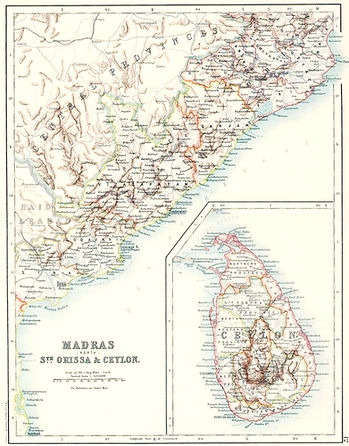
Image. David Rumsey Map Collection, David Rumsey Map Centre, Stanford Libraries.
Published by W. & A. K. Johnston of Edinburgh & London, this map was part of an Atlas of India, .and showed political administrative divisions, cities and towns, the railway system, roads and rivers
1889
India

Image. David Rumsey Map Collection, David Rumsey Map Centre, Stanford Libraries.
A map engraved for the Standard World Atlas published in Chicago by George F. Cram.
1817
Hindoostan with Isle of Ceylon

Image. David Rumsey Map Collection, David Rumsey Map Centre, Stanford Libraries.
A hand coloured map drawn & engraved for Thomson's New General Atlas and published by Baldwin, Cradock, and Joy, John Cumming, John Thomson of London, Dublin, and Edinburgh.
1827
Partie de l'Inde et Ile de Ceylan

Image. David Rumsey Map Collection, David Rumsey Map Centre, Stanford Libraries.
A hand-coloured lithographed map that covers Sri Lanka and parts of Kerala, Karnataka, and Tamil Nadu, part of the six-volume Atlas Universel, published in Brussels by Ph. Vandermaelen. The atlas was the first atlas of the world with all maps on the same scale (about one inch to 26 miles.
1875
Vorder Indien, insets Asam, Ceylon

Image. David Rumsey Map Collection, David Rumsey Map Centre, Stanford Libraries.
Created by A. Graef and G. Haubold, this map was published by Geographisches Institut in Weimar, Germany as part of 2 volume atlas, with countries color-coded to indicate the colonizing European country.
1872
British Possessions In The Indian Seas

Image. David Rumsey Map Collection, David Rumsey Map Centre, Stanford Libraries.
Part of a 27-part atlas created by G.H. Swanston for J. Bartholomew and the publisher Fullarton & Co., this map of British Settlements was compiled using Admiralty Surveys and is surrounded by drawings of the flora, fauna, and people of the possessions.
1851
Overland Route To India

Image courtesy of Middlebury College Special Collections.
A map created by the cartographer and engraver J. Rapkin showing a range of routes - from London to the Red Sea; the Mail Steam Packet Route, the Marseilles and German Overland Routes; the Euphrates Route; as well as routes from the Red Sea to Bombay or Colombo; to Calcutta; the Persian Gulf and Bombay.
1893
Trichinopoli and Ceylon

Image. David Rumsey Map Collection, David Rumsey Map Centre, Stanford Libraries.
A colour map of India’s Trichinopoly district, and Sri Lanka, that shows administrative boundaries, cities, towns, roads, railroads, rivers and mountains. It formed part of the first edition of an atlas of India, one of 60 maps made for John Bartholmew & Co by the Edinburgh Geographical Institute and published by Archibald Constable & Company in London.
1805
Map of The Island of Ceylon
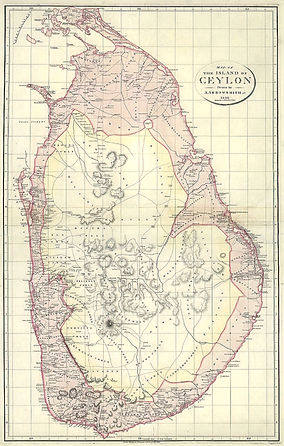
Image. David Rumsey Map Collection, David Rumsey Map Centre, Stanford Libraries.
Drawn by Aaron Arrowsmith, hydrographer to H.R.H. Prince of Wales and published by Arrowsmith, of 10 Soho Square, London, this map of Sri Lanka detailed the British and Kandyan possessions at the end of the first Kandyan War. The British, fearing that French control of the Netherlands would give them control of the strategically important port of Trincomalee, occupied Dutch possessions in Sri Lanka in 1795. British possession would later be enshrined in the Treaty of Amiens of 1802. The interior of the island was controlled by the Kingdom of Kandy, which had lived in uneasy, sometimes violent, peace with the previous colonial incumbents, the Dutch and the Portuguese, for the past 200 years. This uneasiness continued, and in 1803, the first Kandyan War broke out when the British marched into Kandyan territory. Although they successfully occupied Kandy, resistance was more substantial than expected, and the army, weakened by disease, was resoundingly defeated. The war would continue for another two years, with neither side gaining a decisive victory, and it would not be until 1815, when the British overthrew Sri Vikrama Rajasingha and gained control of central Sri Lanka.
1825
Ceylon

Image. David Rumsey Map Collection, David Rumsey Map Centre, Stanford Libraries.
A hand coloured map of Ceylon published in the Atlas created by A. & S. Arrowsmith, No.10 Soho Square, London
1862
Ceylon

Image. David Rumsey Map Collection, David Rumsey Map Centre, Stanford Libraries.
Published for the Church Missionary Society by Seeley, Jackson, and Halliday ion London, this third edition of The Church Missionary Atlas depicts in maps the missions in various countries operated by the Church Missionary Society, showing also roads, buildings and landmarks, rivers, major towns, rivers and mountains as well as numbered references to churches and missions and alphabetical reference to landmarks.
1866
Vorder Indien

Image. David Rumsey Map Collection, David Rumsey Map Centre, Stanford Libraries.
Published by Weimar Geographisches Institut, this map in the 42nd edition of the Atlas (which first appeared in 1856) is one of 5 devoted to Asia, with the lithography colour-coded by region and British possessions, and showing cities, towns, roads, and rivers.
1817
Ceylon
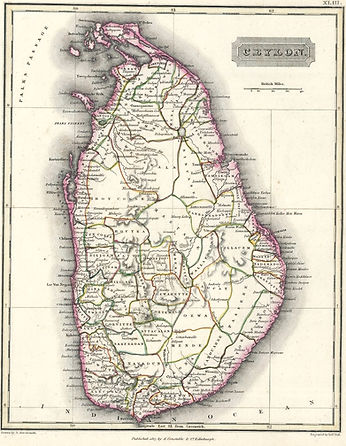
Image. David Rumsey Map Collection, David Rumsey Map Centre, Stanford Libraries.
A map of Celyon from the first edition of the Arrowsmith atlas, engraved by Sidney Hall and published by A. Constable & Co. in Edinburgh and London.