
Cuthbert’s Golden Treasury of Spices in Sri Lanka
KHALID BIN SULTAN
"Aisha heard the Prophet saying, 'This black cumin is healing for all diseases except As-Sam.' Aisha said, 'What is As-Sam?' He said, 'Death."

Image: Public Domain.
Traditional medicines use cumin for pain relief and digestive problems. Modern science has fixed on its principal compounds - thymoquinone and cuminaldehyde – to disentangle its likely abilities as an anti-inflammatory, antioxidant, anti-diabetic, and anti-cancer agent. As a cooking ingredient, it stars especially in Indian, Mexican, African, Mediterranean, and Middle Eastern dishes, and it is no stranger to ambitious chefs either, featuring in trophy dishes like Chocolate and Cumin Fudge, Golden Lassi, Hazelnut Butter, and traditional sausage rolls. In Sri Lanka, it is so loved that it forms a key ingredient in Thuna Paha, the top go-to island curry powder used in countless local recipes.
RUDYARD KIPLING
"Gardens are not made by singing, ‘Oh, how beautiful,’ and sitting in the shade."

Image: Public Domain.
Known in more formal circles as Zingiber Officinale, ginger is a cultigen - one of those rare species that has been so altered by mankind as to no longer exist in its original wild state. Making it took real work. Originating from the rainforest islands of Southeast Asia, it has been modified to fit human culinary and medicinal needs.
OSCAR WILDE
"I adore simple pleasures. They are the last refuge of the complex."

Image: Public Domain.
For so simple-looking a plant, lemongrass is the most complex of food additives, with its unreproducible blend of sweet, tangy, floral, citrusy, and almost ginger-like flavours. It has hallmarked any number of Malay and Thai dishes, particularly fish cakes, curries, and sauces, whilst in the West, there is no better way to start your morning than with a lemongrass tisane at Alain Ducasse’s restaurant in The Dorchester. It is used in many Sri Lankan dishes, but when added to the classic Cashew Curry, it elevates the eating experience to a level only slightly below the gods.
HANS CHRISTIAN ANDERSEN
"I never dreamed of such happiness as this, while I was an ugly duckling."

Image: Public Domain.
Deep at the ugly duckling end of the spice spectrum, the kaffir lime is a small, thorny, scrubby tree with an all-around appearance only a mother could love. It has few animal enemies of any sort. Its leaves appear to double back on themselves in growth, and its tiny, bitter, thick-rinded fruits are shaped like miniature brains.
JULES VERNE
"In a few years, without the numerous causes of destruction, which arrests their fecundity, these plants would overrun the earth.”

Image: Public Domain.
Sri Lanka’s bountiful landscapes, lavish rainfall, rich soils, wider ranging temperatures, and generous range of microclimates from coasts to cloud forest, scrubland to jungle, ensure that there is always somewhere where every spice will grow to its best possible advantage. Cynics say all you need to do is chuck in a few seeds or cuttings into Sri Lanka’s soil, and they will grow with a profusion that needs little human encouragement. And that is especially true in the hills, which make up twenty per cent of the island’s land mass, where the climate, monsoons, soils, and weather patterns make for an alarming fecundity.
MAE WEST
"Love conquers all things, except poverty and toothache."

Image: Public Domain.
Traditional Chinese and Ayurvedic medicine have long used cloves for pain relief, toothaches, digestion, colds, and gum infections, with their power mainly due to their high eugenol content. Modern science is busy reaffirming much of this. Recent studies have shown that it can reduce the SARS virus, combat oxidative stress to mitigate chronic diseases, including cancer, prevent bacterial infections, reduce rheumatoid arthritis pain, and be as effective as benzocaine in relieving tooth pain.
CHRISTOPHER ROBIN
"The most important thing is, even if we're apart, I'll always be with you."

Image: Public Domain.
Coriander, the Marmite of the spice world, is a taste that stays with you long after you have consumed it. You either love it or hate it - a predisposition that is said to be genetic. Its distinctive, pungent, spicy, citrus green taste and aroma are never in purdah in any dish. Native to the Mediterranean and Middle East, and ancient beyond wrinkles, coriander first appears back in 5000 BCE in Sanskrit literature before popping up in the ancient Greek papyri and the Bible - Exodus 16:31, to be exact: “…and the house of Israel called the name thereof Manna: and it was like coriander seed, white; and the taste of it was like wafers made with honey.” The spice travelled with the Romans, Chinese, and Arabs on every possible trade route, spreading rapidly across the globe as ABBA.
AN APOCRYPHAL PROVERB
"Three roots of ginger a day keep sorrow away."

Image: Public Domain.
It is an easy plant to grow, demanding dappled shade, well-drained soil, and high humidity. Rhizomes with green growth buds are planted in shallow depressions, and before long, green leaves, sometimes up to ten feet high, spread out, accompanied by pink or white flowers so perfect in their construction as to look as if they have sprung from moulds. Within eight months, the roots can be harvested and the process restarted. At ten billion dollars and growing, the global market for ginger outstrips production, and so prices are higher than they really need to be.
J.R. WARD
"You're not going to make us play Monopoly again, are you?"

Image: Public Domain.
When the British began the final expulsion of the Dutch across Sri Lanka from 1796, the cinnamon monopoly fell into their hands – but only momentarily. British control of Sri Lanka coincided with the natural dissolution of the global cinnamon monopoly. Plantations that had sprung up in places as far apart as Java to the West Indies were now producing the spice, and merely trying to control it at the Sri Lankan end made little commercial sense anymore. In 1833, the market was opened, by which time the British had introduced a wealth of new crops to Sri Lanka, including tea, coffee, and rubber. But by then, Sri Lanka, by virtue of its spices, had drawn into its heart all manner of things, good and bad, from Buddhism to Love Cakes. Everything the country is today comes, at least in part, from the magnetic draw it first exerted on the rest of the world.
MARIO PUZO
We hope someday to be saints, but not martyrs”

Image: Public Domain.
Consumers of Gotu Kola are more likely than most to end up as saints than martyrs. For this most demure of Sri Lanka’s indigenous species, is something of a Mother Theresa - awash with virtue and value. Known as pennywort or centella asiatica, it is a herbaceous perennial vegetable with small, round leaves that bud from soft stems, like a kind, apple-green version of watercress. It thrives in rich, moist soil, with plenty of shade and manure – the swampy edges of ponds are an especial favourite. The leaf has a subtle, earthy taste, sweet and bitter at the same time and combines exceptionally well with coconut.
DANTE ALIGHIERI
“A mighty flame followeth a tiny spark.”

Image: Public Domain.
Buyers within today’s spice world have shown themselves more than happy to pay out for real quality. Sri Lanka’s gardens, plantations and estates contribute one billion dollars to the twenty-five billion dollar total that is the value of the global spice market – a sturdy total for a small country that has just 0.04% of the planet's total land mass.
WOLE SOYINKA
“A tiger does not proclaim his tigritude, he pounces.”

Image: Public Domain.
Pepper’s rediscovery by Europeans in Kozhikode by the fifteenth-century Portuguese explorer Vasco da Gama set it on a path to a much wider audience, eager to use it as much for cooking as for health. Within decades, it had become so prized that it became a currency in its own right, used to pay rents, taxes, and dowries. It entered the language as “black gold.” And it is as gold that it has continued, with a global market value of over two billion dollars, ten per cent of which is Sri Lanka’s more than marvellous share.
LORD BYRON
“All who joy would win must share it. Happiness was born a Twin.”

Image: Public Domain.
Nutmeg and mace are the conjoined twins of the spice world, two quite separate spices that derive from the same plant, Myristica fragrans. The nutmeg part of it is the hard, round seed found within the fruit; it has a robust, musky flavour, woody, a little sweet, and unmistakably aromatic. The mace is the reddish-orange membrane that surrounds the seed, with a scent that hardened Olfactors would describe as floral, citrus, light, and delicate. The tree that bears them is slow-growing, deciduous, relatively narrow-spreading, but able to reach heights of 20 to 30 meters.
RALPH WALDO EMERSON
“And the bitter lives of the enslaved produced so much sugar that pure sweetness began to spread around the world."

Image: Public Domain.
Sweetness and fine flavour are not much associated with slavery, but in the existence of the small kaffir lime plant, they come most unexpectedly together. Despite the racial slur implicit in its common name, kaffir lime," Citrus Hystrix, as it is known in more Latin quarters, is an indigenous plant right across South and Southeast Asia. It most probably gained its ill-starred name from the Bantu slaves brought to Sri Lanka by the Portuguese, who were known as “kaffirs.” One of its earliest appearances in Western literature is in Emanuel Bonavia’s 1888 book “The Cultivated Oranges, Lemons, etc. of India and Ceylon”. H.F. MacMillan also includes it in his seminal 1910 reference work, “A Handbook of Tropical Gardening and Planting”.
JOHN SKELTON
“As patient and still, And as full of goodwill, As fair Isaphill, Coriander, Sweet pomander, Good Cassander…”

Image: Public Domain.
An annual that grows absurdly easily from seeds, coriander production is led by India, and has mushroomed into a $5 billion-a-year market. Traditional medicines across the world include a wide range of treatments for most problems, from fever, diarrhoea, indigestion, and piles to vomiting, arthritis, and gout. Modern scientific research is a little pickier, but many studies have begun to show its value in treating disorders of the nervous system and diabetes, and in combating malignant microorganisms. The more you cut it, the more it grows.
WINNIE THE POOH
“Could you spare a small smackerel?”

Image: Public Domain.
You don’t need much cumin to make a difference, but what a difference even a little will make. Nutty, warm, slightly bitter and, when toasted, very aromatic, the spice lingers on your palate, reminding you gladly of epicurean pleasures only just past. A prominent member of the parsley family, it appears to have rapidly spread from its home base around the Mediterranean to take over the entire world. Clocking in at almost two billion dollars annually, its production is led by India, with Sri Lanka producing barely enough for its own consumption.
MOOMINTROLL
“Don’t worry little one,' said Moominmamma, 'adventures always come to the adventurous.'”

Image: Public Domain.
Had traders, adventurers, and plunderers never made it to Sri Lanka, bringing with them so many other species that would end up flourishing here, the island’s cuisine would be a rather austere affair – virtuous as a vestal virgin - but little removed from eating water biscuits. Every eager gourmand from Nero to Oscar Wilde would have felt alienated. Imagine curry – that catch-all dish – without chilli, coriander, cumin, or fennel. Or the luscious banana-leaf-wrapped Lamprais that the Dutch brought with them from Indonesia – but without their heady aroma of cardamom, cloves, black pepper, and cinnamon. Picture Sr Lankan Butter Cake or the Love Cake introduced by the Portuguese, but without vanilla. Sambal without ginger. Watalappam without cinnamon – dishes brought here by Malay migrants. Butch Sri Lankan Bruedher Bread without nutmeg. Or Rassam tamarind soup – but without tamarind. It is like imagining prison. Through every century, the island has not only welcomed new spice species but also new dishes and recipes, integrating them into its local cuisine, making them almost as endemic as the Purple-faced Langur Monkey or the Sri Lankan Blue Magpie - animals found nowhere else in the world but here.
RABINDRANATH TAGORE
“Facts are many, but the truth is one.”

Image: Public Domain.
No other thing, except perhaps Buddhism itself, water, or Sri Lanka’s island status, has had such a marked impact on the country as has cinnamon. It is the magnetic North of the world’s spices, having enticed traders, colonists and planters to Sri Lanka, the invisible force field of its glittering commercial allure sucking them in, willing monopolist marketers, villainous vendors, wolfish merchants. The consequences of their commercial obsession were to remake the island - utterly.
CHRISTOPHER SMART
“For nutmeg is exceeding wholesome and cherishing, neither does it hurt the liver.”

Image: Public Domain.
By the early eighteenth century, the first nutmeg plantations in South Asia were recorded in Kerala, just across the sea from Sri Lanka itself, the work of an enterprising Scottish planter. Exactly when they came to Sri Lanka and where they were first planted is a matter of mildly rumbustious academic debate. The global market for both species is relatively small in value, oscillating around 250 million dollars annually, with half coming from Indonesia and Sri Lanka accounting for about 5 per cent of the total, mostly from small plantations around Kandy, Kegalle, and Matale.
FRANK HERBERT
“He who controls the spice, controls the universe.”
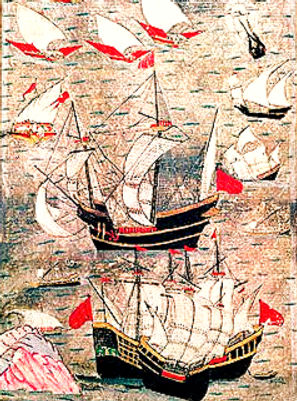
Image: Public Domain.
What had begun with a breeze in a few sails became an armada of vessels from Europe as the first European colonists set out to break the monopoly of the Indian Ocean trade and take it over for themselves. First came the fifteenth-century Portuguese, who established ports, routes and colonies in East Africa, southwestern India, and the islands around the Javan Sea, fuelled by the cinnamon, cloves, nutmeg and pepper of SE Asia. Breaking the Arab traders' monopoly, they took over the lucrative trade – until the Dutch stepped in. With the establishment of the Dutch East India Company in 1602, the Portuguese stranglehold over the spice trade was broken. The Dutch brought with them a draconianly more commercial mindset, setting up Sri Lanka as a de facto cinnamon estate, shortening the trade routes dramatically and developing across the island an infrastructure of canals such as the famous Hamilton Canal, which linked Negombo to Colombo; roads; large, professionally managed commercial plantations especially around Negombo; and stringent laws to maximize what was to become one of the most profitable monopolies the world had ever seen. Huge fines and, sometimes, deportation to Africa were imposed on anyone who cut down a cinnamon tree, wild or otherwise, without permission.
ERMA BOMBECK
“I am not a glutton, I am an explorer of food”

Image: Public Domain.
Pepper is one of Sri Lanka's great indigenous spices. It is one of only two food items (the other being salt) to have earned a place as one of the immutable fixtures at every table in almost every part of the world. Yet this extreme popularity belies its opulent history. Food historians have dated pepper’s origins to the Malabar Coast of India – present-day Kerala- and to around 2,000 BCE, by which time Adam’s Bridge, that frail corridor of land that connects India with northern Sri Lanka, was already several thousand years old. Rising and falling sea levels meant that, over time, it became more or less walkable – but indeed the presence of black pepper so close to Sri Lanka probably implied its existence on the island too, brought here by birds, early migrants, or just by creeping, acre by acre, when the land was dry.
WINNIE THE POOH
“I did mean a little larger small helping.”

Image: Public Domain.
You can never have enough cardamom. Cardamon, the green pearl and Queen of Spices, is so prized as to be the world’s third most valued spice, up there with saffron and vanilla, with a scent and flavour so intensely exotic as to be deeply associated with magic potions, love remedies and spiritual practices that go back to the Hanging Gardens of Babylon. It has a taste and fragrance like no other spice.
JANE AUSTEN
“I must learn to be content with being happier than I deserve.”

Image: Public Domain.
All spices, to some degree, enhance the flavour of food and add to its aroma, turning what is simple into something compellingly complex and delicious. But in this matter, democracy quite breaks down, for not all spices are equal. Some, a very few, play the part that red, yellow, and blue do in painting – primary colours from which all others are derived. These primary spices do more than merely complement a dish; they set the tone, establishing the foundational flavours that await your palate. Food writers and chefs argue long and hard about the rightful membership of the list – but most seem to agree on the top nine: turmeric; cinnamon; pepper; cardamom; cloves; chilli; coriander; cumin and ginger.
W. H. AUDEN
“I smell blood and an era of prominent madmen.”

Image: Public Domain.
Cinnamon is the greatest of Sri Lanka’s indigenous spices. No other thing, except perhaps Buddhism itself, water, or Sri Lanka’s island status, has had such a marked impact on the country as this miraculous spice, beloved of Herodotus, Aristotle, Nero, and such famous chefs as Vivek Singh and Emma Bengtsson. It is the magnetic North of the world’s spices, having enticed traders, colonists and planters to Sri Lanka, the invisible force field of its glittering commercial allure sucking them in, willing monopolist marketers, villainous vendors, wolfish merchants. The consequences of their commercial obsession were to remake the island - utterly. But that is, of course, not the fault of the plant itself, and not even the fact that it has been expropriated in name by hotels and insurance companies, wellness spas, buns, babies, and kitchenware can detract from its epic health and culinary properties.
MARCUS AURELIUS
“In short, know this: Human lives are brief and trivial. Yesterday a blob of semen; tomorrow embalming fluid, ash.”

Image: Public Domain.
A herb long associated with mummifying much, fenugreek originated in Turkey six thousand years ago. It became so widespread as to appear with residential ease in the texts, medicines, and recipes of the first Mesopotamian and Indian civilisations, as well as those of ancient Egypt, Greece, and Rome. Use it, advised the Egyptian Ebers Papyrus in 1550 BCE, to embalm the dead, purify the air, and cleanse the tummy. A central component of Ayurveda and traditional Chinese medicine, it was regarded with great suspicion by Western medicine – until recently. It is now enjoying an investigative renaissance as labourites around the world probe its antidiabetic, anti-obesity, anticancer, anti-inflammatory, antioxidant, antifungal, and antibacterial properties.
WINNIE THE POOH
“It never hurts to keep looking for sunshine.”

Image courtesy of Botanistry
As long as it has access to lots of sun, curry leaves from the sweet neem tree are the most straightforward of plants to grow, growing well from cuttings and root divisions and are afraid of few, if any, animals. It reaches heights of around four meters quickly and tolerates all soil types and prolonged periods of dryness. Its small pinnate leaves are a commonplace ingredient in Sri Lanka and are no longer the Mr Quiet of the spice world, becoming ever better known outside of South and SE Asia and China.
PIGLET
“It’s so much more friendly with two.”

Image: Public Domain.
Cardamom is the spice world’s twin spice, coming as it does in two variants – Green cardamom, which has a very intense flavour, and Black cardamom, which is cooler and smokier. Black cardamom comes from the Amomum plant, which grows on the slopes of the Himalayas, but the green variety, known scientifically as Elettaria, is the true cardamom. Green cardamom grows best in deep shade in wet, hilly, tropical or sub-tropical areas with plenty of rainfall. Reaching bushy heights of up to 15 feet, it takes three years before it starts bearing seeds that can be harvested. The difficulties and time required to grow the spice help explain its production focus, with Guatemala and India accounting for the vast majority of the nearly one billion dollars it generates annually. Sri Lanka’s own production, centred mainly around Kandy, Matale, Kegalle, Nuwara Eliya, and Ratnapura, accounts for a tiny proportion of the total.
KOBAYASHI ISSA
“Listen, all creeping things, the bell of transience.”

Image: Public Domain.
Unlike so many other spices, pepper is a walkover to plant, harvest and maintain. A vine that grows to four meters and lasts for at least three decades, it proliferates interplanted in home gardens on the island and as a commercial crop in such areas as Matale, Kandy, Kegalle, Badulla, Ratnapura, and Kurunegala. Cuttings are planted to grow up Gliricidia tree stakes, which pump nitrogen into the soil around them. Its green berries, like tiny grapes, are harvested twice yearly from June to August and again from November to February, and dried and blanched to become black. White pepper is made from the same fruit but is soaked in water for several days, then rubbed clean of its outer coating. Its peppery-hot taste deters most animal attacks, though not those of songbirds, who are so configured by nature as to feel no burning sensation when they guzzle its grapes.
STEPHEN FRY
“Nothing in this world is as it seems. Except, possibly, porridge.”
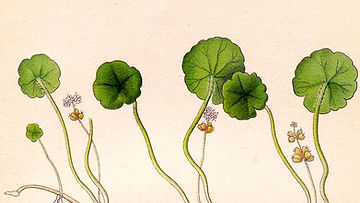
Image: Public Domain.
In Europe, the herb Gotu Kola has yet to make the leap from specialist natural food shops to supermarkets, but here in Sri Lanka, almost any vegetable shop sells it. It stars in many island dishes, but the most famous is as a porridge. Kola Kanda, or Gotu Kola Herbal Rice Porridge, to give it its full and formal name, is a comfort food that is ridiculously easy to make. Red rice and a bit of garlic are boiled up. Gotu Kola and curry leaves are blended to a fine dust, strained, and added to the cooked rice with coconut milk. The gorgeous green porridge is poured into breakfast bowls and served with a piece of sweet jaggery – and so begins a better day.
WINNIE THE POOH
“Oh, bother.”

Image: Public Domain.
Vanilla is perhaps the fussiest and most bothersome of all species to grow, as only the Melipona bee and two species of Mexican hummingbirds could ensure the pollination of the tiny flowers to create the vanilla pods. The bees and the birds, patriotic to a fault, refused to live outside Mexico, and it was not until 1841 that a twelve-year-old slave, Edmond Albius, discovered how to hand-pollinate the plant. The vanilla market that this discovery was to go on to create is today valued at well over six billion dollars, though much good it did poor Albius. It took years for his French masters to even unenslaved him, and he was to die in poverty and neglect by 1880. His obituary in a local newspaper noted that “the very man who, at great profit to his colony, discovered how to pollinate vanilla flowers has died in the hospital at Sainte-Suzanne. It was a destitute and miserable end. His long-standing request for an allowance never brought a response.” Eighty per cent of the world's vanilla now comes from Madagascar, with Sri Lanka making up such a tiny percentage as to be all but invisible.
WINNIE THE POOH
“One of the advantages of being disorganised is that one is always having surprising discoveries.”

Image: Public Domain.
Spice gardens exist in most parts of the country, but most especially in the highlands around Kandy, where the balance of climatic and environmental conditions is, as Voltaire might have stated, had he called in on Kandy, “all for the best in the best of possible worlds.” Here, a striking form of gardening unique to the island comes into play – the Kandyan gardening technique, a system developed in this region 500 years ago. The method, still practised here, is open to anyone with a garden – and a mindset to plant it so it mimics a disorganised tropical rainforest. Dig for Victory never looked so good. Erosion is minimised, fallen leaves keep soil temperatures at kinder levels, and fertility is enhanced. It is as if a sumo wrestler had squeezed himself into a pair of shiny jeans. In spaces of an acre or two – and often less than that - taller trees are interplanted with shorter ones. Shrubs, creepers, and ground cover are allowed to prosper. The resulting fusion garden typically includes jackfruit, mahogany, mango, teak, avocado; smaller fruits like banana, papaya, rambutan, and guava; medicinal trees like beli and neem; vegetables; ornamental plants, orchids, ferns, and crotons – and of course as many spice plants as can be squeezed in. The multi-layered garden that busts out has astonishing biodiversity – and an embarrassment of virtues: a self-sustaining ecosystem that boosts soil health and plant resilience to disease.
EMILY DICKINSON
“One step at a time is all it takes to get you there.”

Image: Public Domain.
Clove trees - Syzygium aromaticum - are slender and reach about 40 feet tall. It takes them over 6 years to grow before producing buds. But they then stick at the job for some eighty years, making clove orchards things of great value. Although they grow with relative ease and resist most animal attacks, they are challenging to manage, requiring careful, time-sensitive hand-harvesting to pick the buds at the optimal time. Once the leafy structure that encases a flower bud changes from green to pink, and just before the petals themselves open, is the time to pluck them. They then must be separated from their stalks and left to dry gently in the sun.
FOLK SAYING
“Run, run as fast as you can. You can't catch me, I'm the gingerbread man”

Image: Public Domain.
The culinary form of ginger has two main variants: red for medicine, and white for cooking. Its sweet, citrusy flavour, as well as its peppery heat, changes during preparation. When raw, it is at its most pungent; when dried, it is at its hottest; and when cooked, it is at its sweetest. From ginger cakes and ginger beer to stir-fry ginger beef, it is used in many dishes across the world – but perhaps none so celebrated as with Gingerbread men. England’s first Queen Elizabeth even had an official royal gingerbread maker whose sole role was to make such pastries, once famously creating edible clones of all the foreign dignitaries who assembled at her 16th-century court. In Sri Lanka, it is especially favoured in chicken and sambal dishes.
EDMUND SPENSER
“Sleep after toil, port after stormy seas, Ease after war, death after life does greatly please.”

Image: Public Domain.
Mathottam in Mannar, in the northwest of Sri Lanka, became a key trading hub for spices, pearls, ceramics, and ivory. North of Jaffna, Dambakola Patuna became another such hub, famous for later welcoming the sacred Bo tree into the country. Close by, the port of Urathota Kayts specialised in shipping horses and elephants. It is clear from inscriptions discovered there from around the middle of the twelfth century CE how finely regulated was this trade, with one reading “if the vessels bringing elephants and horses to us get wrecked, a fourth shall be taken by the treasury and the other three parts shall be left to the owner…”
TOO-TICKY
“Sometimes one has to go through darkness to reach the light.”

Image: Somasiri Devendra.
Very little is known about how Sri Lanka, through its own shipbuilding and merchant fleets, moved beyond its role as a spice trade hub to become more active in transportation. But it did. Marine historians have begun to believe that at least until the late tenth century CE, the island was active and capable of making ocean-going cargo boats, constructed from wood and held together by coconut fibre ropes that were sufficiently robust as to work the seas between India, the Maldives and up to present-day Pakistan.
WOLE SOYINKA
“The hand that dips into the bottom of the pot will eat the biggest snail.”

Image: Public Domain.
Nutmeg contains elemicin, a compound now being researched for its antidepressant properties, its ability to modulate gut flora, and its potential to promote overall good health. Harvesting nutmeg is far from simple – the art lies almost wholly in the drying process. Too dry and they are so depleted of oil as to lose all flavour. Too moist, and mould develops. The mace coating the pod is best removed straight from the shell in a single go, forming a single piece, for cleaning and drying.
ERIC HOFFER
“The short-lived self, teetering on the edge of extinction, is the only thing that can ever really matter.”

Image: Public Domain.
Moringa is a short-lived, fast-growing, ten-metre-high tree, indigenous to India and Sri Lanka. It matures with good-tempered ease, demanding only tropical temperatures, water, and good drainage. Barely known outside Asia and Africa, it is a spice to covet. Every part of the plant is edible. Its leaves can be used in salads or boiled like spinach. Its flowers make an excellent tea, and its seed pods, when young, are a rare alternative to asparagus. Its taste is grassy, a little bitter with an agreeable horseradish-like heat and flavour, which explains why it is also known as the horseradish tree.
PHILIP LARKIN
“The trees are coming into leaf, Like something almost being said.”

Image: Public Domain.
As you would expect from such a special spice, nutmegs inhabit the fussy end of propagation, demanding rich, well-drained soil at around 500 meters, nicely distributed rainfall of about 2,500 mm per year, a decent amount of shade, especially in their first years, and temperatures that range from 20 to 30 degrees.
EZRA POUND
“The what is so much more important than how.”

Image: Public Domain.
Today, barely a dish made anywhere is without pepper; sometimes it’s the star, as in Steak au Poivre; often it’s the chorus; occasionally it’s the saint, as in David Lebovitz’s award-winning Black Pepper Ice Cream.
SOCRATES
“There is only one good, knowledge, and one evil, ignorance.”

Image: Public Domain.
Pepper was the go-to cure to reverse the effects of hemlock, the poison that killed Socrates. It has beneficial chemical properties derived from the alkaloid piperine, its main active compound, though it also contains other valuable compounds such as tannins, potassium, calcium, magnesium, Vitamin C, Vitamin B1, B2, B3, and Vitamin K. Modern science has since validated some of these presumed health benefits. The alkaloid piperine it contains has obvious antioxidant properties. Scientific studies have also linked it to anti-inflammatory benefits. Indeed, when combined with turmeric and ginger, the spice was found to have the same impact as prescription medication for patients with knee osteoarthritis. On-going medical studies are also examining piperine’s potential in cognitive functioning; lowering harmful cholesterol levels; regulating blood sugar, providing pain relief; boosting the immune system by supporting white blood cells; treating vitiligo - and, most interesting of all, as a use in cancer drugs where its antioxidant and free-radical scavenging properties are of possible benefit in chemoprevention and controlling tumour growth.
CONFUCIUS
“Three things cannot long be hidden: the sun, the moon, and the truth.”

Image: Public Domain.
Unlike Cinnamon aromaticum or Cinnamon cassia, which come largely from Vietnam and Indonesia and are commonly known as Chinese cinnamon or Ceylon Cinnamon, or, to give it its Latin name, Cinnamomum verum, comes almost exclusively from Sri Lanka. This is true cinnamon. The most significant difference between the two variants of cinnamon lies in their health qualities. Of the eighty or so chemical compounds that make up both varieties of cinnamon, there is little to compare in how well they are known to improve insulin, increase blood sugar uptake, reduce cholesterol, and, with their shared anti-inflammatory and antioxidant qualities, act against bacteria and fungi - even to the extent of stopping the growth of tumours. Both also help prevent the buildup of tau, a substance in the brain that can lead to Alzheimer’s disease. The way they metabolise into sodium benzoate mitigates the loss of proteins like Parkin and DJ-1, thereby inhibiting the progression of Parkinson’s Disease. The polyphenols in both varieties help detoxify enzymes, protecting against the growth of cancer cells. Their shared cinnamaldehyde component activates thermogenesis, a process that increases calorie burning. But where they differ is in their inclusion of coumarin, an aromatic organic compound with known hepatotoxic and carcinogenic properties, and one that is known to cause liver damage. Compared to Chinese cinnamon, Sri Lankan cinnamon has extremely low levels of this dangerous chemical - 250 times less, to be exact. It is therefore the only sure variety to use for health benefits.
SAMUEL GOLDWYN
“Too caustic? To hell with the costs, we'll make the picture anyway.”

Image: Public Domain.
One of Sri Lanka’s lesser-known spices is brindleberry – known here as Goraka, or to give it its full and formal Latin honorific, Garcinia gummi-gutta. It is the Lewis Carroll of the spice world for the White Rabbit must have had its mercilessly caustic taste in mind as he wandered through Wonderland: “The Queen of Hearts, she made some tarts, All on a summer day: The Knave of Hearts, he stole those tarts, And took them quite away!” It is a slow-growing rainforest tree that reaches about 20 meters in height, with dark, shiny leaves and rough, black bark. It is an unfussy plant, growing happily so long as it has its roots in deep, well-drained, slightly acidic, light clay soil.
GEORGE ORWELL
“Under the spreading chestnut tree, I sold you and you sold me."

Image: Public Domain.
Most of Sri Lanka’s spices came here by accident or design. Arab traders brought cardamom from the Western Ghats of Southern India, as well as fenugreek and possibly cloves and pandam leaves: the British imported nutmeg and mace to break the Portuguese and Dutch monopolies on these spices in Indonesia. Vanilla, a plant native to South America, arrived via the Portuguese. Chilli peppers, also originally from the Americas, reached Sri Lanka in the sixteenth century. Three classic Mediterranean, Middle Eastern, and African spices – tamarind, coriander, cumin, and fennel – arrived here on trade routes powered by the Arabs. As did ginger, which originated in the Pacific region of Southeast Asia.
JEAN-PAUL SARTRE
“We are our choices.”

Image: Public Domain.
Cardamon oil, derived from its seeds, undergoes many stages of olfactory change as it is heated. Words like peppery, piney, eucalyptus, menthol, citrus, sweet, peppery, pungent, aromatic – they all land far short of quite how extraordinary it is. Unique as it is, its bioactive properties have long made it a key ingredient in many ancient medical systems, from Ayurveda to the Chinese Compendium of Materia Medica. Modern science is busy validating its benefits in combating diabetes, cardiovascular diseases, and disorders of the respiratory and gastrointestinal systems. It is even beginning to show promise in preventing some cancers. In Scandinavia, it has transformed a range of basic foods from mulled wines to pastries, raising them to addictive levels of gourmand refinement. Poached fruits, pies, cupcakes, biriyanis, biscuits, teas, dhals, scones and stews: there is little that will not yield to and be improved by the spice. Arriving in Sri Lanka, courtesy of Arab traders working the sea routes to the Malabar coast, is the likely reason it arrived here, where it is used in cakes and curries, puddings, and rice.
GERARD MANLEY HOPKINS
“What is all this juice and all this joy?”
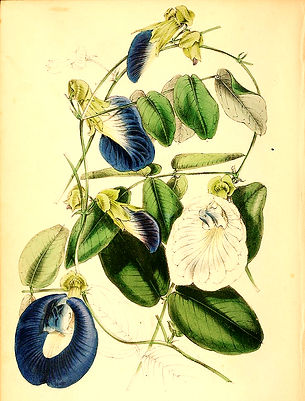
Image: Public Domain.
Ancient medics were firm in their belief that the blue butterfly pea flower could do much for human health - improve memory, reduce stress and depression, minimise the outward signs of ageing and mitigate inflammation. Modern science is now busy confirming most of this - and adding to its tally of benefits. The unique cyclic peptides that make up one of its cornerstone active ingredients have been found to help lower blood glucose and insulin levels, as well as combat certain bacteria. But all of this pales into off-stage mumblings when compared to its colour – for the pure sapphire blue hue it gives to many recipes, especially teas – this, even though its taste is easy to miss, being mildly floral at best. Little else denotes such modern sophistication today as sitting and sipping a warm glass of cornflower-blue Clitoria Tea.
Among the world’s key spices, Sri Lankan cinnamon holds its own, costing up to $60 a kilo – more than cloves, though less than saffron ($500 to $5,000 per pound), vanilla ($200 to $500 per pound), or cardamom ($30 per ounce).
RUMI
“What you are seeking is also seeking you.”

Image: Public Domain.
Gotu Kola is popular in traditional medicine, where it is believed to promote longevity and good vision. Modern science is catching up on the beneficial effects of its principal compounds – especially triterpenoid saponins, naturally occurring sugars. Studies suggest this has many applications: as an antiviral to inhibit the replication of viruses like herpes; as an antioxidant; as an anti-neoplastic to combat cancers; and to promote collagen production. Other studies are in progress to identify how it helps improve memory and support blood circulation.
MAHAGAMA SEKERA
“You and I, and all of us, are journeying towards a morning star…”

Image: Public Domain.
Pepper is the second great indigenous spice for which Sri Lanka is rightly famous. But for real pepper buffs, black pepper has a cousin that, though little known, is infinitely grander – long pepper. Both are indigenous to Sri Lanka and are members of the Piper genus within the Piperaceae family. Where they differ is in their taste. Whereas black pepper is candidly pungent, long pepper is way more complex – hotter, sweeter, with delectable hints of incense, cloves, and nutmeg. It grows like a catkin, so red as to resemble a runaway mulberry.
ROBERT LOUIS STEVENSON
“You too, my mother, read my rhymes, for love of unforgotten times…”

Image: Public Domain.
Vanilla, introduced to Sri Lanka by its colonists, is the Mummy of all spices – its taste, connotations, associations, and aroma reminding you of the perfect home, overseen by someone not unlike Mrs Darling in Peter Pan or Tove Jansson’s beloved Moominmamma. For it is as a cooking ingredient that it is best known today, its warm, decadent, woody fragrance making cakes, ice cream, milkshakes, yoghurts, custards, and pies the kind of dishes that live on in your imagination long after you have consumed them. Here in Sri Lanka, it is most lovingly associated with Sri Lankan Butter Cake. This cake is a happy evolution of the classic English pound cake, which first appeared in 18th-century London in Hannah Glasse's 1747 cookbook, The Art of Cookery. Flour, baking powder, lots of butter, eggs, salt, milk, and vanilla make up the cake itself and – for Sri Lanka anyway – it is frosted with passion fruit butter and filled with chopped mangos.
DU FU
"Cease to harbour concerns that you will be powdered."
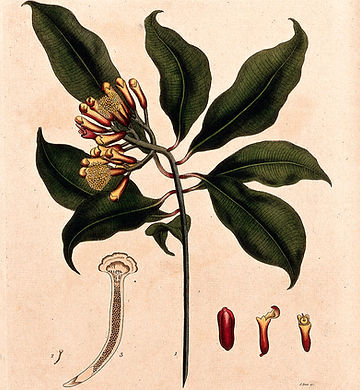
Image: Public Domain.
Because cloves require high humidity to ensure the proper development of the flower bud, good drainage, rich soil, and abundant rainfall, they are now grown mostly within 10 degrees of the equator. Worth around seven billion dollars annually – and growing fast, almost half the production comes from Madagascar, with a little under ten per cent from Sri Lanka, especially from small plantations around Kandy, Kegalle, and Matale. Here, the climatic conditions are so beneficial that cloves are renowned amongst buyers for their richer, more intense oils and flavour.
RICHARD HENRY DANA
"Here is the tamarind tree: I must sit under it, for the sake of the old song."

Image: Public Domain.
Tamarind, native to Africa, has been growing in India and probably Sri Lanka since at least 1300 BCE, roughly the same time as the civilisations of the late Bronze Age around the Mediterranean collapsed. It has godly properties, being included in the Book of Enoch, one of those texts that was banned from inclusion in the Bible; and in the Hindu Epic, the Ramayana, a text that Hindus believe dates back 1.2 million years, though scholars argue for a later date - around 5,000 BCE. Indeed, it was old enough to be included in some of the earliest Indian Ayurvedic texts – the Charaka Samhita, the Sushruta Samhita, and the Nighantus. Its very name appears to hint at its travel history: "tamarind" is derived from the Arabic phrase “tamar hindi,” which means "Indian date." Commonly added to ayurvedic medicines to treat constipation, digestive disorders, arthritis, blood disorders, wounds, and cell health, it is now undergoing deeper scientific studies for its pharmacological properties, helping with asthma, liver problems, diabetes, and dysentery.
RAINER MARIA RILKE
"I am so glad you are here. It helps me realise how beautiful my world is."

Image: Public Domain.
Although awash with potassium, sodium, calcium, iron, phosphorus, vitamin C, vitamin B3, and vitamin B6, as well as several oils, turmeric’s most crucial component is curcumin. This is the active ingredient that gives the spice its stunning colour and most of its critical health benefits. Modern scientific research is homing in on its quantifiable properties. Studies have begun to show how it can help in treating inflammations, degenerative eye conditions, arthritis, cholesterol, and kidney health, as well as possibly mental conditions: depression, anxiety, and dementia.
DOLLY PARTON
"If you want the rainbow, you gotta put up with the rain."
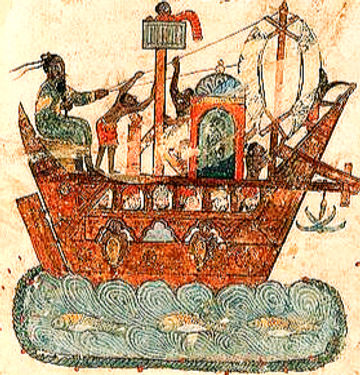
Image: Public Domain.
Monsoon winds filled the sails of cargo boats along the Swahili Coast and on the western seaboard of India, right across to the ports of Java. Predictable as clockwork, these annual winds allowed merchants to fund long journeys within fast, predictable, and relatively safe seasons. From May to September, the southwestern monsoon blows from the west to the east, helping ships sail from Africa and the Arab world to Asia. Between November and March, the northeastern monsoon takes boats in the opposite direction. Budgets could be made, profit measured, and risks taken. By medieval times, these routes expanded dramatically at either end to bring the whole of Europe, and Central Asia into the mix – though the engine still sat squarely within the Indian Ocean – in ports like Zanzibar, Mogadishu, Hormuz, Calicut, Malacca, and across the coastline of Sri Lanka itself.
HIPPOCRATES
"Let food be thy medicine and medicine be thy food."

Image: Public Domain.
Pepper’s extreme antiquity was spectacularly displayed when pepper corns were found in the nostrils of Ramses the Great, who died in 1213 BCE, and whose mummy was unearthed in 1881 in the Valley of the Kings. Arab traders brought it to the attention of the ancient Greeks, mainly as a medicine used to alleviate haemorrhoids, diarrhoea, and digestive disorders.
WINNIE THE POOH
"My carrot will never make it through the new year with all of you around!"

The Carrot, Willem Frederik van Royen, Märkisches Museum
Fennel owes its remote DNA to carrots. It is a staple ingredient in the Sri Lankan kitchen, prized for its sweet, liquorice-like flavour, the Paddington Bear of the spice world, easy to grow from seeds in full sun, its base bulb ready to harvest after just three months. Native to the Mediterranean, the plant was widely known across the ancient civilisations of the region and travelled swiftly and almost unnoticed to Asia and beyond – including Sri Lanka, one of the many discreet gifts of the Indian Ocean trade. Its sweet, grassy taste is often incorporated into many Sri Lankan dishes, from curries to Watalappan.
ROALD DAHL
"Those who don't believe in magic will never find it."

Image: Public Domain.
Spices have woven a most persuasive spell across Sri Lanka. They sit up there along with gods, language, myths, music and miniature schnauzers, parts of our shared human existence, able to retain an elemental magic and as impervious as a seam of gold to all attempts to mine them or reduce them to something merely transactional. Their stories, histories, homes, admirers, and journeys form an accretion of remembrances that explain why they stayed the course as they moved from jungle and moor to supermarket shelf and checkout. Even now, they are much, much more than mere bottles of dried flavour. One whiff of pepper or cardamom, cinnamon or cloves is sufficient to conjure up places and memories as potent as the sound any seashell makes of the sea when you place it to your ear. In the smell of each spice is much of the whole history of the world: its rulers, presents, writers, planters, merchants, alchemists, chefs, doctors. And it's great explorers. Marco Polo; Xuanzang, the seventh-century Chinese Buddhist monk; Hippalus; Joao Ribeiro; Ibn Battuta; Vasco da Gama; and Zheng He, the fifteenth-century Chinese admiral.
ALAIN DUCASSE
"You can mix two styles and get fusion; any more, and you just get confusion."

Image: Public Domain.
Moringa is widely used in Sri Lankan cooking, a favourite addition to all things fish, and its stars with the most incredible lustre in the island’s celebrated Spicy Drumstick Curry dish. But if it’s a touch of fusion food you are really after, go down the moringa-as-asparagus route. Collect young, tender pods around a foot long before they become too woody. Trim them into smaller asparagus-like lengths, add onion, butter, and salt, and boil for 10 minutes. Then steam the pods in a marinade of oil, vinegar, sea salt, pepper, garlic, and parsley and enjoy them with all the sophisticated delight that made Louis XIV’s obsessive consumption of asparagus so memorable as to figure in every contemporary Versailles diary.
W. H. AUDEN
There's always another story. There's more than meets the eye.

Image: Public Domain.
Rich in such vitamins as A, C and E, chilli’s natural chemical compounds, especially capsaicinoid, have prompted a wave of ongoing scientific research into harnessing it to promote weight loss, relieve pain from arthritis, reduce inflammation, control LDL (bad) cholesterol to lower the risk of strokes and heart attacks and regulate blood sugar. Some studies have also indicated its potential use in killing cancer cells.
PHILIP LARKIN
“A good meal can somewhat repair / The eatings of slight love.”
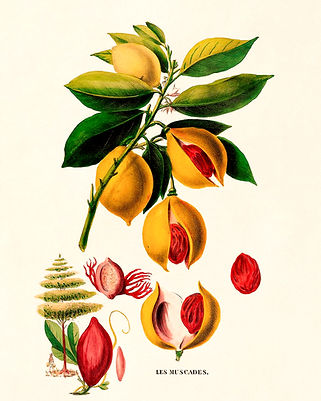
Image: Public Domain.
Nutmeg has found its way into several popular, preprepared spice mixtures, such as garam masala. Still, it is more classically known as the one spice equally at home in sweet and savoury dishes - game pies, apple crumble, Swedish meatballs, eggnog, macaroni cheese, chutneys, curries, Christmas pudding, frittatas, quiches. Indeed, in the seventeenth century, the beau monde Europeans would carry their own personal nutmeg graters to season food to their own particular liking. Sri Lankan nutmeg is most famously featured as a key ingredient in watalappam, the island’s version of creme caramel, a spicy coconut custard sweetened with jaggery. Mace, given its more delicate flavour, is perhaps best enjoyed in Congee, a comfort food like few others – a rice porridge made with coconut milk and heavily flavoured with herbs, vegetables, and mace.
EUGENE DELACROIX
“A taste for simplicity cannot endure for long.”

Image: Public Domain.
Goraka fruit, which resembles doll’s house-sized pumpkins, is first dried before its flesh is used in place of lime or tamarind to give dishes, especially fish dishes, a distinctly tart taste. The fruit badly needs this pre-preparation, as it is otherwise far too acidic to eat raw. Its most famous island offering is Ambulthiyal, the classic Sri Lankan sour fish curry, where, as part of a mix of spices, the fish turns the meat a stylish black as the walls of a Soho literary cocktail bar. In Ayurvedic medicine, Goraka is used to treat ulcers and digestive problems. Western medicine is now busy studying its hydroxycitric acid content to better design medicines that increase fat burning whilst simultaneously reducing fat accumulation and appetite. Some scientists also believe it can help manage cholesterol, stabilise blood sugar levels, and protect the body from cell damage.
ACARANGA-SUTRA
“A type of pepper that should not be accepted by monks or nuns if unmodified.”

Image: Public Domain.
As a vine, long pepper resembles black pepper but demands greater shade and more water to really flourish, and the sort of perfect drainage for which good plumbers win gold medallions. In cooking, it can be used much like black pepper, yet makes curries bolder, marinades zestier, and stews famously more aromatic. For anyone seeking the ultimate recipe, look no further than Long Pepper Chicken, which first surfaced somewhat unexpectedly in the Arthashastra, a 2nd-century BCE Indian Sanskrit treatise on statecraft, politics, economic policy, and military strategy. It is a simple dish to prepare. Add crushed long pepper, ginger, and salt to the yoghurt, then add the chicken pieces, and let them marinate overnight. Then add mustard seeds to hot oil, more peppers, and then the marinated chicken, until it browns. Squeeze lemon over the result and try not to wolf it down disgracefully.
JOHN BETJEMAN
“And now, dear Lord, I cannot wait because I have a luncheon date.”

Image: Public Domain.
Gourmands would also argue that Sri Lankan cinnamon has a flavour that is arresting, in its difference – sweeter, more subtle, and less bitter than Cinnamon cassia. It has a softer texture and a lighter colour – and, commanding a much higher price than Chinese cinnamon, accounts for just 9% of the world’s $1 billion market. As one food writer put it: “Cinnamon is the flavour equivalent of being hugged by your grandmother.” From fruit pies and custards, sweet breads and rolls, teas, soup, lattes, pilaf, baked meats, pancakes, cakes, dumplings and pot roasts, its delicate nature allows it to complement dishes rather than dominate them, war-lord style. Imagine some of the world’s great dishes like Kanelbullar, beef rendang, lamb tagine, apple crumble, Franzbrotchen Buns, or Teurgoule rice pudding – but without cinnamon to transform them. Across Sri Lanka, the spice has found its way into dozens of classic island dishes, including Watalappan, a spiced coconut and jaggery custard; Bibikkan; Dutch Lamprais; Kavum, sweet rice-flour treacle fritters; and scores of common curries.
SHEL SILVERSTEIN
“Anything can happen, child. Anything can be.”

Image: Public Domain.
Ginger probably arrived in Sri Lanka with Arab traders, but its travel schedule is so ancient as to be all but lost. The Rig Veda, which dates to around 1400 BCE and is the world’s oldest Vedic text, mentions ginger, and later ayurvedic books elaborate on its medicinal qualities - to reduce indigestion and nausea, stimulate the respiratory and nervous system, and, by improving blood circulation, act as an aphrodisiac. Recent scientific studies that have tabulated sexual function, fertility, and testosterone levels suggest that there may be something in this. Western science has also set in train a wave of further forensic research into the clinical applications of ginger in cancer control, menstrual pain, glucose levels, and the treatment of arthritis.
SEAMUS HEANEY
“Believe that a further shore, is reachable from here.”

Image: Public Domain.
The very earliest trade in spices was as much, if not more, promoted by their medicinal qualities as by their culinary impact, a feature that is wholly reversed today. Such spices as cinnamon, turmeric, cinnamon or pepper were known and neatly incorporated into the traditional remedies used by medics of the first ancient societies - the Greeks, Romans, and Egyptian; the Xia, Shang, Zhou, Qin and Han of ancient China; and the Sumerians, Babylonians, Assyrians, Hittites, and Phoenicians in what is today the Middle East. And within all of South Asia - and parts of SE Asia - Ayurveda, the 5,000-year-old Vedic Indian holistic medicine system, had long since integrated spices into the treatments and therapies that were commonplace across the Indian sub-continent. The development of Western science since the early modern period refocused attention away from many of the health benefits of these spices, and empirical scientific research worldwide is only now beginning to catch up on their benefits.
TERRY PRATCHETT
“Did you ever visit Gomorrah?’ ‘Sure,’ said the demon. ‘There was this great little tavern where you could get these terrific cocktails with crushed lemongrass…”

Image: Public Domain.
For reasons best known to travel agents, Sri Lanka’s indigenous lemon grass, Cymbopogon Citratus, gained the moniker “West Indian Lemongrass” somewhere along the way. It is one of only two species of Cymbopogon that are treasured in all the ways lemongrass should be, the other being Cymbopogon flexuosus, a variant more inclined to produce oils and medicines used in foods. Greener, thicker, more fragrant, and harder to grow, Sri Lanka’s native so-called West Indian lemongrass is the one to be found in discriminating kitchens. Although modern science has yet to fully determine the impact of its various bioactive compounds, it has, in large part, endorsed the characteristics that have made it a popular ingredient in folk medicine: relieving pain and arthritis, reducing blood pressure, inhibiting infection and vomiting, and combating gastrointestinal disorders and fevers.
ROBERT BROWNING
“Earth is crammed with heavens.”
Image: Public Domain.
In cooking, every part of coriander can be used – its intensely flavoured seeds, its grassy leaves and stalks, even its delicate white flowers, which pair very well with cheese. It appears in any number of curries from South to SE Asia, as well as – famously in Yemeni Zhug, Salsas, Tiger Salad, the carrot Potage de Crécy soup, Egyptian bissara dips, and, of course, Sri Lankan Kothamalli Tea – the go-to comfort drink that everyone sips on the island if feeling mildly out of sorts.
CHITRA BANERJEE DIVAKARUNI
“Fenugreek, Tuesday's spice, when the air is green like mosses after rain.”

Image: Prof. Dr. Otto Wilhelm Thoméderivative
The plant, an annual, grows to a bushy two feet in height, happiest in full sun and is well able to tolerate drought. Its celery-tasting leaves are often used in curries and salads. Still, it is its seeds that attract the greater use, giving dishes a nutty, maple-like taste with hints of curry, as in Aloo Methi, the Indian potato curry or Persian Sabzi stews. In Sri Lanka, its seeds are especially enjoyed when combined with a few onions, chilli, garlic cloves, tamarind, and plenty of thick coconut milk to make a simple vegetarian curry.
PETER FRANKOPAN
“From the beginning of time, the centre of Asia was where empires were made.”
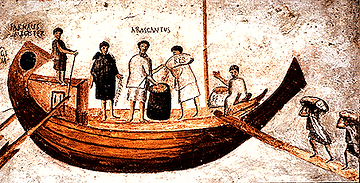
Image: Public Domain.
Like gold, silk or the tin that produced the Bronze Age, spices were the impetus for a significant part of the ancient world’s economic explosion, opening sea and land routes, connecting east to west, and exposing cultures, ideas, languages, religions, and technologies to societies that had never before heard of one another. They started their journey, of course, on foot - prehistoric land routes – from Africa into the Middle East; from Australasia and Indonesia into China; and then from both directions towards India. By the time the civilisations of the ancient world were stirring, these land routes had multiplied into sea routes – the maritime Silk Route, bringing Africa into contact with SE Asia through India and Sri Lanka, which sat like a belly button in the middle.
ELIZABETH BARRETT BROWNING
“How do I love thee? Let me count the ways.”

Image: Public Domain.
The vanilla pod has an astonishing 250 chemical properties to it, one of which, vanillin, is known to increase serotonin production - the happy hormone. More excitable scientists are also busy investigating how it increases male testosterone levels, making it an aphrodisiac. Others, perhaps more grounded, are focusing on its ability to promote healthy ageing and better memory, combat indigestion and insomnia, and help reduce the risk of sickle cell blood disorders.
ROBERT FROST
“I crave the... aftermark of almost too much love, the sweet of bitter bark, and burning clove.”

Image: Public Domain.
It is as a food item that cloves are most cherished. From glazed hams to candied oranges, tea to biscuits, trifles to curries – there is an unending wealth of recipes, such as Sri Lankan Garlic Clove Curry and Seeni Sambol. They have even made it the prize ingredient in Sykurlaus kryddkaka, the national cake of Iceland, and in Pickled Muktuk, a favoured Thanksgiving dish of whale blubber cooked in Alaska.
T. S. ELIOT
“I learn a great deal by merely observing you, and letting you talk as long as you please, and taking note of what you do not say.”

Image: Public Domain.
Chilli quickly found its way to Sri Lanka, and other parts of Asia, due in large part to the Portuguese and their commercial thirst to control the Indian Ocean trade - and with it, its lucrative spice revenues. The spice’s adoption into Sri Lankan cookng came with an etymological twist, for the Singhala term for pepper (“miris”) was transferred to chilli. Pepper was renamed “gam-miris” – literally “village pepper.” Its penetration across the island seems to have been slow, if the journals of Robert Knox, the famous British captive of the King of Kandy, are anything to go by. Knox’s book, “The Historical Relation of Ceylon”, published in 1681, recorded just about anything that moved and most things that didn’t. And it fails to mention chilli. More than anything else, this probably indicated the limited reach of the Portuguese settlement, which never properly incorporated the highlands of the Kandyan kingdom.
SYLVIA PLATH
“I ride earth's burning carousel. Day in, day out.”
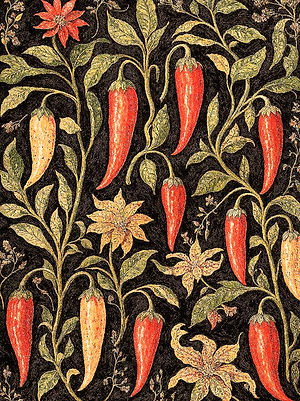
Image: Public Domain.
It is for its taste and flavour that chilli is most widely celebrated. And in this regard, there are as many influences as there are outcomes. Different varieties of chilli pepper, their ripeness, colour, drying process, and growing conditions – all influence how exactly they taste and smell. Smokey? Fruity? Grassy? Tart? Warm? Hot? Blistering? The vegetable’s extraordinary range and adaptability have ensured it can cover all these bases and more, making it one of the kitchen’s most flexible ingredients. From chilli pickle to chilli con carne, many dishes that incorporate chilli have become household favourites everywhere. Barely a dish in Sri Lanka fails to include it – from sambals and curries to the sweetly exquisitely spicy banana pepper curry - and of course Lunu Miris, one of the island’s top pickles, made from finely chopped onions, red chilli flakes, salt, lime juice, and Maldive fish, and able to go with just about anything. Foodies like to debate which cuisines tend to be hotter – Sri Lankan or Indian. But the answer is far from straightforward, as it all depends on which regions you have in mind: the Chettinad or Kandy, Galle or Rajasthan, Tamil Nadu or Jaffna?
JORGE LUIS BORGES
“I walk slowly, like one who comes from so far away he doesn't expect to arrive.”

Image: Public Domain.
Vanilla pods, once grown, require careful processing before they are fit for market. The beans need to be heat-treated to stop growth and activate the enzymes that produce the pod’s flavour. They then need to be wrapped up to ferment to bring out their flavour. Several weeks of sun drying follow, the pods are turned daily, before they are left to rest for three months to mature. What few vines exist in the country have lingered in the imagination of vanilla dreamers, and connoisseurs claim that Sri Lankan vanilla has a more subtle, caramel, and delicate flavour than Madagascan vanilla. Egged on by the indefatigable Sri Lanka Export Development Board, attempts are being made to increase production, and the Kandy-based Vanilla Grower Association now claims to have 1000 members. It typically grows up glericidia poles. Their flowers, which last but a day, usually bloom between December and February; once pollinated, the pods take around eight more months to develop before they can be harvested.
WILLIAM BLAKE
“In the universe, there are things that are known, and things that are unknown, and in between, there are doors.”

Image: Public Domain.
The very centrality of Sri Lanka within the maritime Silk Route of the Indian Ocean was to prove its commercial making. Cosmas Indicopleustes, a Greek writing in the sixth century CE, noted that “the island being, as it is, in a central position, is much frequented by ships from all parts of India and from Persia and Ethiopia; and it likewise sends out many of its own. And for the remote countries…it receives silk, aloes, cloves, sandalwood, and other products, and these again are passed onto marts on this side, such as Male, where peppers grow…”
e. e. cummings
“It takes courage to grow up and become who you really are.”

Image: Public Domain.
Enthusiastic - and largely blighted- attempts were made to grow vanilla in Sri Lanka at titanic levels. The Burgher planter Antoine Joseph Van der Porten planted acres of the vine on his plantation in Halgolla. It should have been a triumph as the island, especially around Kandy, had the perfect climate and environment for the plant. Little capital investment was needed to raise it, and it showed a strong resistance to disease and pests. Its failure to take off may have been due in part to the lingering complexity of self-pollination. However, its execution is relatively straightforward once learnt. Using a thin stick or even a blade of grass, the flower’s flap is opened, and the stamen and stigma are gently pressed together. Bingo. Never had sex been so untroubled.
WINNIE THE POOH
“I’m so rumbly in my tumbly.”

Image: Public Domain.
Winnie the Pooh and Fennel were made for one another. Pooh’s oft-reported tummy troubles might easily have been treated had he reached out for this distinctive herb. A component of many traditional medicines, fenel has long been used to relieve colds and digestive problems. Modern science seems to validate this, with studies showing how one of its main compounds, anethole, helps relieve stomach ailments. And perhaps more interestingly, further research indicates that it can also help prevent liver disease.
C.P. CAVAFY
“My life has been awaiting you. Your footfall was my own heart's beat.”

Image: Public Domain.
Few Asian and Arab dishes would be the same without turmeric. Dosas, bhajis, samosas, Moroccan pastillas, Tunisian tagines, aloo gobi, butter chicken, chana masala, kormas, rendangs – all owe their appeal in large part to their inclusion of turmeric; as do newer entrants, from martinis to sourdough bread. Rice, dhal, chicken stew, coconut milk, curries, custards, jackfruit pickles and even puddings: across Sri Lanka, there is barely a recipe that fails to touch on turmeric in one way or another.
DR. SEUSS
“Oh the places you’ll go.”

Image: Public Domain.
Until relatively recently, Sri Lanka’s source of cloves had been a matter of debate, with some historians pointing to the Portuguese and others to Arab traders. However, the discovery a few years ago of a pot containing cloves, excavated in the ancient port of Mathottam in the northwest of the island and dating back to 900-1100 CE, suggests that the clove trade was already well established long before the first European colonists arrived. Indeed, the only clove discovered anywhere else in the world that predates this one is one found in Syria, perfectly preserved since 2000 BCE. Interestingly, the Sri Lankan clove was not excavated in isolation. It was found alongside many other preserved cereals and grains and 11,418 pottery fragments from 123 different wares, a quarter of which were clearly imports - indicating that in this port, as no doubt in others, a dynamic and cosmopolitan settlement was in progress – like Dubai, only older and greener. Detailed research on the clove in question has since revealed that it came from the Maluku Islands in today’s Indonesia – a 7,000-kilometre journey.
SAPPHO
“Once again love drives me on, that loosener of limbs, bittersweet creature against which nothing can be done.”

Image: Public Domain.
Sri Lanka’s Viagra alternative is the blue butterfly pea flower - Clitoria ternatea – the most erotic and secretive of indigenous spices. An immodest, fast-growing vine that reaches lengths of around fifteen feet, it is, by dint of its etymological origins, considered something of an aphrodisiac; the genus part of its name (Clitoria) derives from "clitoris", a shape faithfully reproduced in the plant’s blossom. Science has backed up its reputation as a love drug. A study published recently in the International Journal for Herbal Medicine noted that “the milk treated group showed a significant increase in body weight, sperm count, motility and sexual behaviour parameters compared to the control group.” Ayurvedic texts dating back many thousands of years before this study were conducted could have told them not to bother, as the flower has long been used in traditional Asian medicine to improve overall sexual vitality.
MOLIERE
“One should eat to live, not live to eat.”

Image: Public Domain.
For such a small item, pepper makes whatever dish it touches potent, adding an earthy, mildly hot flavour that hints of figs, citrus, pine, smoke, and wood. And from its earliest beginnings, nurtured by the humid climate and heavy rainfall that the plant loves, it has long been one of the pivotal ingredients that make Keralan stews, roasts, and rassams distinctive. The Romans began tentatively using it in their cooking, and the spice makes an early culinary appearance in the ancient Roman cookbook Apicius’ De re coquinaria.
ALLEN GINSBERG
“Our heads are round so thought can change direction.”

Image: Public Domain.
By the sixth century, the ancient port of Gokanna – now Trincomalee – was welcoming spice merchants from China, Ethiopia, Saudi Arabia, Greece, Rome, India, and Persia, all drawn in part by its ideally provided resources for ship repair, easy docking in a huge safe harbour and the availability of plenty of fresh water and food. Some merchants continued their journey from the port into the Mahaweli River, deep into the island itself. Further south, the port of Godawaya near Hambantota prospered. In fact, historians have recently demonstrated how almost a third of all Roman coins found on the island come from the southwest coast, indicating that its ports were of great significance from the earliest times. Godawaya itself is recorded as returning to the Anuradhapura kingdom, with notable tax revenue from the second century CE.
LI BAI
“Shade and light are different in every valley.”

Image: Public Domain.
Pandam leaves are Asia’s secret spice. It transforms dishes with its grassy-green, vanilla-like flavour. Growing to about three feet in height, it is known colloquially as screw pine for the spiralling arrangement of its leaves. It is an easy plant to grow, requiring little attention but for water and a splash of shade. It hit the botanical headlines as late as 1813 when Scottish botanist William Roxburgh described it. His famous catalogue of Calcutta Royal Botanic Garden’s plant species noted that the plant had been donated in 1798 from the island of Ambon, in Indonesia.
C. S. LEWIS
“Some journeys take us far from home. Some adventures lead us to our destiny.”

Image: Public Domain.
Nutmeg trees have a staggeringly limited commercial history, with all specimens worldwide deriving from plants that once grew only on the Banda Islands, a collection of islets that make up the 17,508 islands that comprise Indonesia today. Identified by the Portuguese as a primary source of revenue, the spice became one of the most tightly controlled monopolies of the Indian Ocean trade. The Arab traders who had been carrying and selling it across the region were muscled out, and until 1621, the Portuguese managed to keep trade in this spice to themselves. Naturally, this also meant a tight grip on production, and the various Portuguese governors across the East Indies took special care to ensure that no live plants escaped from Banda. When the Dutch eventually stormed the Banda Islands and wrested control of nutmeg from the Portuguese, little else really changed. The Dutch VOC Company maintained as tight a grip on the production, transport, and marketing of spices as its colonial predecessors did.
DYLAN THOMAS
“The force that through the green fuse drives the flower drives my green age.”

Image: Public Domain.
In today’s spice trade, India accounts for 75% of the world’s total metric tons of spices, and although Sri Lanka owns barely 1 %, the island still prides itself on the quality, not the quantity, of its spices. And in this spice connoisseurs agree - for Sri Lankan cinnamon or pepper, for example, has a caviar quality of taste and perfume that plays with bewitching delight to the senses, as do no others.
JOHN BURNSIDE
“The heaven of childhood had something to do with citrus…”

Image: Public Domain.
Curry leaves give all the dishes they touch an earthy citrus-like flavour and a scent as if lemon grass and star anise had been twinned in some ecstatic horticultural coupling. It is especially delicious when fried with cashew nuts. Picked and used fresh off the tree, like basil in Italian cooking or marjoram in Greek dishes, there is almost no South Asian dish to which it cannot be added to deepen both flavour and scent. It has long been a staple ingredient in Ayurvedic medicine for treating skin and hair problems and for combating indigestion, bloatig, and constipation. Western science is studying its various chemical properties, especially its carbazole alkaloids, to improve cancer and anti-inflammatory therapies.
BOB DYLAN
“The tree of life is growing where the spirit never dies…”

Image: Public Domain.
Known as the “tree of life,” moringa is, according to several authoritative scientific studies, ridiculously healthy. Its dried leaves offer seven times the Vitamin C of oranges, nine times the protein of yoghurt, ten times the Vitamin A of carrots, and fifteen times the potassium of bananas. It is widely used in Indian Ayurvedic medicine to mitigate heart disease and as an anti-inflammatory, anti-cholesterol, antidepressant, and antioxidant. It may also help you see better and grow more luxurious hair. The ancient Greeks used it in perfume. The Egyptian pharaohs depended on it for their complex death rituals. Warriors consumed it before battle.
ANTHONY BOURDAIN
“The way you make an omelette reveals your character.”

Image: Public Domain.
As societies became more sophisticated and consumer preferences increasingly influenced economies, the culinary benefits of spices turbocharged their use and exchange. Cooking, after all, is a form of psychotherapy, marvellously mood-changing. Many spices contribute to the texture and colour of food. Many also aid food preservation and increase its nutritional value.
NICHOLAS CULPEPER
“Their vices are corrected with long pepper, ginger, cinnamon, or mastich.”

Image: Public Domain.
For real pepper buffs, black pepper has a cousin that, though little known, is infinitely grander – long pepper. Both are indigenous to Sri Lanka and are members of the Piper genus within the Piperaceae family. Where they differ is in their taste. Whereas black pepper is candidly pungent, long pepper is way more complex – hotter, sweeter, with delectable hints of incense, cloves, and nutmeg. It grows like a catkin, so red as to resemble a runaway mulberry. It has somehow joyfully resisted most attempts to commercialise its growth properly, despite its reputation, at least in Indian Ayurvedic medicine, as being a stalwart tool to help manage obesity, liver disorders, asthma, lung strength, rheumatoid arthritis, and high cholesterol. It is also promoted as something that sharpens the brain, slows ageing, and enhances a flagging libido. However, empirical evaluation of this aspect of the fruit remains sadly lacking.
WILLIAM BUTLER YEATS
“Though leaves are many, the root is one.”

Image: Public Domain.
Turmeric is one of Sri Lanka’s most important spices. It is one of those rare spices that has dominated the tropical zones of the world since records began, appearing in archaeological findings in Australia dating back to 10,000 BCE, in cuneiform texts from the Assyrian kingdoms in the seventh century BCE, and in Vedic medicine of South Asia, 1000 to 500 BCE. Its cultivation in Sri Lanka ground to almost zero during the troubled decades of the civil war, and turmeric, as it slowly recovers in local production, is still seen as horticultural gold, commanding over 3,000 rupees per kilo. In many ways, it is a pleasing spice to grow, making few demands on its attendants. Fresh rhizomes, with budding green shoots, are planted a few centimetres deep. Sun, good drainage, mulching, and water do the rest. Where it falls just short of perfection is in the allure it offers to wild boar. They adore its roots, its leaves, the taste, and texture of the whole plant. What amounts the boar leaves behind are ready to harvest after seven or eight months, after which time the rhizomes can be replanted for a new crop.
U2
“To be the bee, And the flower, Before the sweetness turns to sour…”

Image: Public Domain.
Tamarind’s primary compound, tartaric acid, is what gives it its sour flavour – this characteristic being the reason it is so liked in Thai and Indian dishes for the gentle and complex layer of acidity it adds to curries, soups, stews, chutneys, and sauces, as well as in desserts and drinks. It pops up in Massaman, Rassam, and Pad Tha; in tamarind jam in Costa Rica; in tamarind beer in the Bahamas; and, since 1876, in England’s legendary Lea & Perrins’ Worcestershire sauce. In Sri Lanka, it is most widely used in curries made with fish, chicken, and pork. It grows as a long-lived evergreen tree, reaching heights of 80 feet in good sun and well able to withstand droughts. Lightly covered with pinnate leaves, its modest red and yellow flowers develop into hard, six-inch knobbly pods, the flesh within them being the best part of the tree to use.
MAYA ANGELOU
“Try to be a rainbow in someone's cloud.”

Image: Public Domain.
The taste of a kaffir lime is remarkable, much more citrusy and floral than that of any other lime, and for this reason alone, it is the secret weapon of all top chefs. It is used in place of traditional limes to give things the sort of intensity that only good rock music can otherwise bestow. Thai chefs have taken it to heart, using it for standout Massaman curries and Tom Yum soups. In Sri Lanka, it is mainly featured in Fish stews and beetroot curries. Its intense flavour and acidic nature also make it a favourite ingredient in other products, from leach spray to shampoo.
WILLIAM COWPER
“Variety [is] the very spice of life, that gives it all its flavour.”

Image: Public Domain.
It is remarkable to note that barely ten of the spices found in Sri Lanka can genuinely be regarded as native to the island - moringa, long pepper, gutu kula, curry leaves, brindleberry, lemongrass, the blue butterfly pea flower, turmeric - and the two spices that stand head and shoulders above the rest: cinnamon and pepper.
WALT WHITMAN
“We were together. I forget the rest.”

Image: Public Domain.
Third-century BCE records from the Chinese Han dynasty refer to the cloves as “hi-sho-hiang” or "bird’s tongue,” and recommend that the Emperor’s officers chew some before starting a conversation with their fastidious overlords. The Ayurvedic Charaka Samhita, dating back to the first century CE, also recommends it as a medicine, as did the Roman Pliny the Elder (23-79 CE). It is probable that cloves grew as permanent features of ancient plantations in India and Sri Lanka and had already taken root well before the European colonists arrived, for the Portuguese and later the Dutch spent much time trying to uproot them, in an effort to enforce the monopoly they enjoyed with this spice from their control of its primary source in Indonesia.
C.P. CAVAFY
“What shall become of us without any barbarians? Those people were a kind of solution.”

Image: Public Domain.
Chilli only reached Asia in the past five hundred years, originating from Peru and Bolivia before being brought to the attention of a marvelling Spanish court by Christopher Columbus after his first voyage to the New World. In the diaries he kept on his journey, Columbus noted the existence of this new plant in an entry dated 15 January 1493, saying it was “a better spice than our pepper”. Within decades, chilli had become a commonplace plant in Spanish gardens. By the mid-fifteenth century, it was to be found as a cooking ingredient from Scandinavia to the Balkans.
MOOMINTROLL
“Why did we have to grow up and think of all these complicated things?”

Image: Public Domain.
Cinnamon pruning starts at about 18 months, with cross branches removed and the plants kept to a height of around 3 metres. Twice-yearly harvesting occurs after about three years, at which point the branches are cut, the leaves removed, and the outer layer of bark scraped off with a Surana Kurutta knife. The raw stems are rubbed with brass rods to squeeze out the oils, and then, with the aid of a special curved knife – a Koketta – the softer inner bark is peeled to a target width, with different widths determining the final grade of the spice. Thirteen different grades are recognised, determined largely by the diameter of the quill. The highest, known as Alba, has quills that are less than 6mm in diameter. More typically, C4 is around 13-15mm in diameter, and C3 is between 15 and 17mm in diameter. All three are known as “Heen Kurundu” or Smooth Cinnamon. “‘Gorosu Kurundu'” includes quills that are up to 38 mm in diameter - typically used for grinding into cinnamon powder. The cinnamon sheaths are then dried in the shade, curling inwards; the quills are then placed on strings or racks to dry still further.
PABLO NERUDA
“You can cut all the flowers, but you cannot keep spring from coming.”

Image: Public Domain.
The global monopoly on nutmeg and mace lasted until 1810, when the British captured most of the Dutch East Indies, including the Banda Islands. Although the islands were returned to the Dutch 4 years later, the British had by then taken particular care to uproot as many nutmeg trees as possible for distribution and regrowth across their own Empire – including Sri Lanka, which it formally gained in 1802 at the Treaty of Amiens. Likely, the monopoly was quietly ended a few years earlier, if reports of the French seizing a cargo of Dutch nutmeg trees and carrying them off to the Caribbean are to be believed. Either way, the nutmeg monopoly had been ended.
MICHAEL ONDAATJE
“You touched your belly to my hands in the dry air and said, I am the cinnamon peeler's wife. Smell me.”

Image: Public Domain.
As a growing spice, cinnamon likes life hot but not blistering – a steady temperature of around 25˚C to 32˚C. Although the soils best suited to it are reckoned to be the sandy white soils of Negombo, its demand for plenty of moisture makes it a firm fixture in the central hilly area of the country. It is grown most easily from seeds, 3-4 per pot, and planted out about 4 feet apart in these clusters, whose competing roots ensure a beautifully shrubby plant, best able to give off many branches to peel, and so limit the dangers of any one plant racing to become a fifteen metre tall tree.